Janome sewing machine troubleshooting: the drop-in bobbin difference explained
What goes wrong most on Janome machines, how the drop-in bobbin changes every fix, and a ranked repair checklist for thread balling, tension, and feed problems.
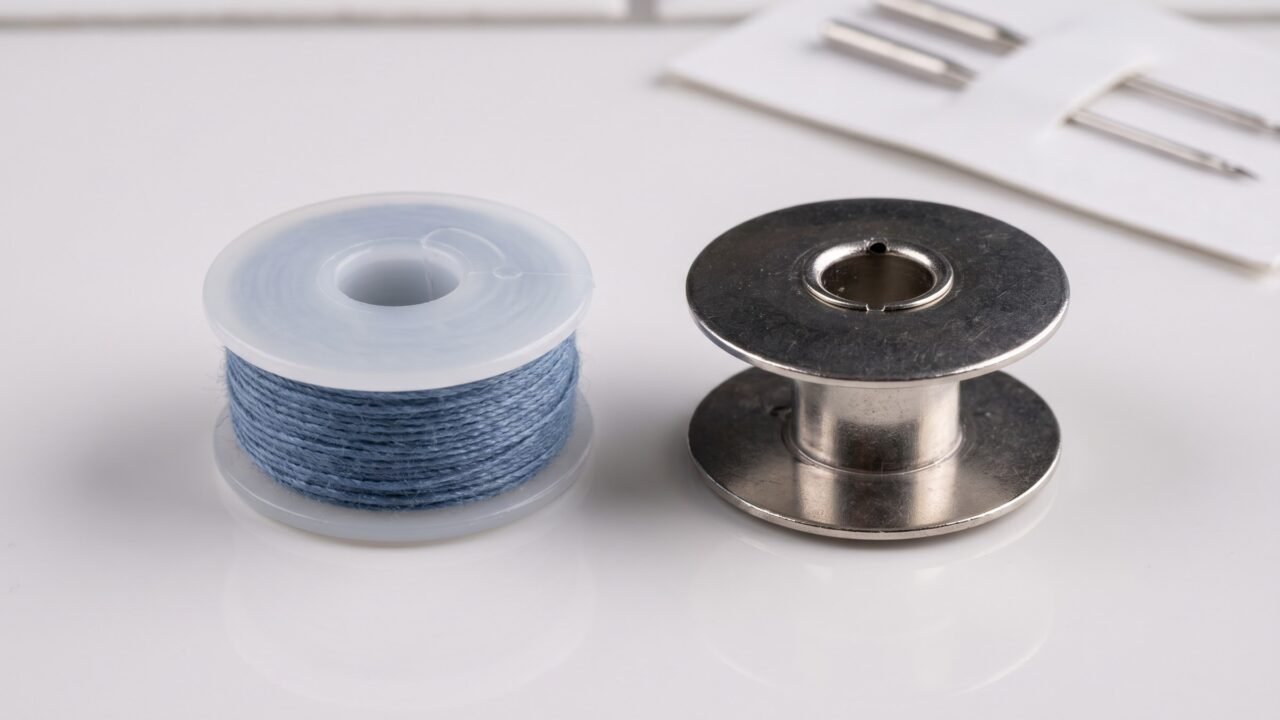
Six symptoms hit Janome owners more often than anything else: thread bunching under the throat plate, skipped stitches, the machine refusing to pick up the bobbin thread, tension that drifts for no obvious reason, fabric that stops feeding, and mid-seam jams. Most share a common root cause - and it is almost never the bobbin itself. Before diving into the fixes, one piece of Janome-specific anatomy changes every diagnosis you will ever run on these machines.
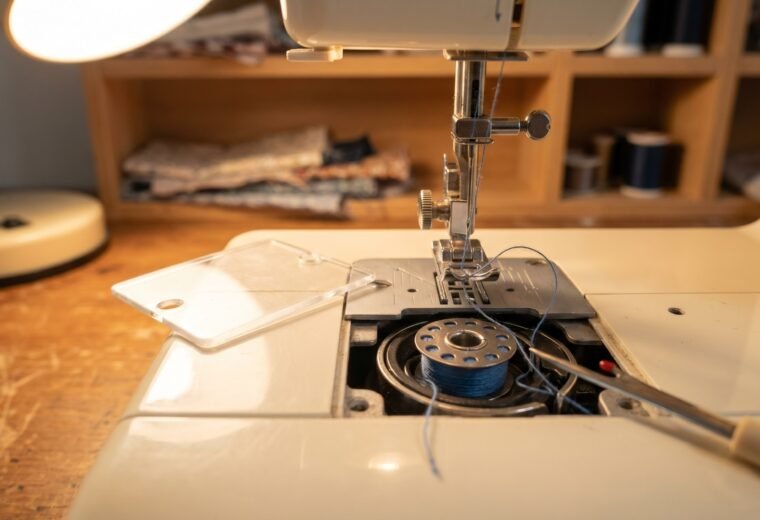
Janome built its reputation on the drop-in (top-load) bobbin, and nearly every machine the company has sold since the mid-1990s uses this design. The bobbin sits face-up in the race under a clear cover plate, which makes it easy to check the thread level mid-project. The mechanism also includes a small magnet that holds the bobbin holder in place. That magnet is why Janome's own guidance is explicit: plastic bobbins only in top-load machines. This is rarely the thing actually going wrong, though. Most owners never accidentally fit a metal bobbin because it does not seat properly in the top-load race in the first place, so treat it as a last check after rethreading, not a first suspect.
What goes wrong most on Janome machines
The table below covers the six symptoms Janome owners report most, the likeliest cause for each, and the ranked fix order. Work from the top of each fix column down - you will solve most problems before reaching step three.
| Symptom | Likeliest cause | Fix order | DIY limit |
|---|---|---|---|
| Thread balling under fabric | Top thread not seated in tension discs (threaded with foot down) | 1. Rethread with presser foot UP. 2. Fresh 90/14 needle. 3. Reseat bobbin in its slot. | Full DIY |
| Skipped stitches | Bent, dull, or wrong-type needle | 1. New 130/705 needle, correct TYPE (ballpoint for knits), then correct size. 2. Rethread. 3. Clean bobbin race. | Full DIY |
| Machine not picking up bobbin thread | Bobbin not following thread path through tension spring | 1. Remove and rethread bobbin, check thread runs through the slot and spring. 2. Rethread top. 3. Inspect hook for lint. | Full DIY |
| Tension off (loops on top or bottom) | Threading error before touching the dial | 1. Rethread top (foot UP). 2. New needle. 3. Confirm plastic bobbin, correct class. 4. Then try dial. | DIY for top tension; bobbin screw = technician |
| Fabric not feeding | Feed dog lever switched down, or stitch length at 0 | 1. Check feed dog lever is UP. 2. Set stitch length above 0. 3. Clean lint from around feed dogs. | Full DIY |
| Machine jams mid-seam | Lint-packed bobbin race or top thread caught in mechanism | 1. Cut all threads, remove bobbin cover, clear lint with a brush. 2. Rethread completely. 3. Check throat plate screws are tight. | Full DIY for lint jam; bent hook = technician |
How the drop-in bobbin changes the diagnosis
On a front-load machine the bobbin sits inside a removable metal bobbin case, and tension on the bobbin thread is adjusted with a small screw on that case. On Janome's top-load design there is no separate case to remove - the bobbin drops straight into the race and a built-in tension spring on the throat-plate cover controls bobbin thread drag.
This has three practical effects on troubleshooting.
First, the bobbin thread path is shorter and more exposed. If the thread is not routed through the slot and under the tension spring on the clear cover, it will feed freely with no resistance at all. The result looks exactly like a tension problem but the dial is completely innocent. Pull the bobbin out, lay the thread back through the slot carefully, and test again before adjusting anything.
Second, the plastic bobbin matters. Janome's top-load race uses a small magnet to seat the bobbin holder, which is why the company says to run plastic bobbins only. In practice a metal bobbin is a rare culprit, because it does not seat cleanly in the top-load race to begin with, so check it only after a full rethread has failed rather than reaching for it early. The far more common bobbin mistake is fit. Janome ships its own plastic bobbin with a 'J' stamped on the centre post (the J stands for Janome) and describes it as a basic Class 15 bobbin. Class 15 and Class 15J bobbins are the same physical size and generally interchangeable - the J in 15J refers to the hook or case style, not a different bobbin dimension. The real incompatibility to watch is Class 15 versus Class 66 (a smaller, squatter bobbin used in older Singer-style front-loaders), and metal versus plastic where the machine specifies plastic. Third-party bobbins that are a touch bigger, smaller, or curved can drag unevenly or jam the case regardless of the class label. Match the bobbin spec'd for your exact model in the manual rather than buying on looks. Our bobbin class guide lists the common Janome families alongside their correct bobbin type.
Third, oiling is different. Janome's top-load machines have a small felt wick recessed under the bobbin area. That wick takes one drop of sewing machine oil - not two, not a "good coat," one drop. Getting oil on the bobbin case surface or the hook itself will cause the thread to slip and produce the same loops-on-the-back symptom as a threading error. Everything else on the machine follows standard oiling rules: sewing machine oil only, never WD-40 or 3-in-1, never compressed air to clear lint. For the full drop-in oiling procedure, the drop-in bobbin cleaning and oiling guide covers it step by step.
Thread balling under the throat plate: the Janome fix order
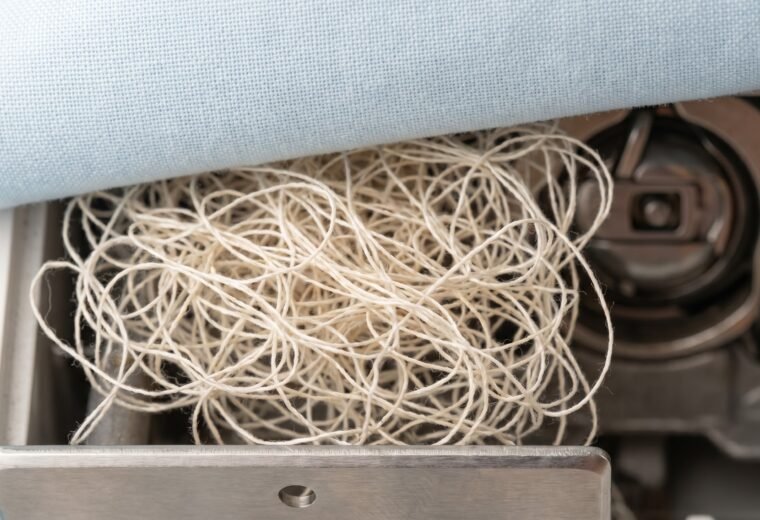
A bird's nest of thread under the fabric is the complaint Janome owners search for most, and the cause is almost always the top thread, not the bobbin. When you thread the machine with the presser foot lowered, the tension discs stay pinched shut and the thread slides around them instead of seating inside them. The machine then has no grip on the top thread, which gets pulled down through the fabric and wraps around the bobbin area in a tangle.
The fix runs in this order, no shortcuts:
- Raise the presser foot lever. Remove ALL thread from the machine, including the bobbin.
- With the foot still UP, rethread the top path completely, following every guide in sequence.
- Insert a fresh 90/14 (or the size correct for your fabric) 130/705 H needle, flat side facing back, and seat the shank firmly at the top of the needle clamp before tightening the screw.
- Drop in the bobbin - plastic, correct class - with the thread following the slot and clipping under the tension spring on the cover plate.
- Hold both thread tails behind the presser foot when you start your first test seam.
If bunching returns after all five steps, the next check is the bobbin race itself. A tiny thread fragment caught in the hook or a lint-packed race will grab the top thread on every pass. Remove the clear cover and the bobbin, brush out any lint with a dry bristle brush (never blow it out with compressed air - that drives lint deeper into the mechanism), and look for a thread tail wrapped around the hook post. Our guide on what causes thread bunching goes deeper into diagnosing the rarer cases where the hook geometry itself is at fault.
Tension: read the stitch before you turn the dial
The Janome tension dial ranges from 0 to 9 on most mechanical models, with 4 to 5 being the balanced default for medium-weight fabric. Adjusting the dial is the last fix, not the first. Most tension complaints resolve with a rethread and a new needle.
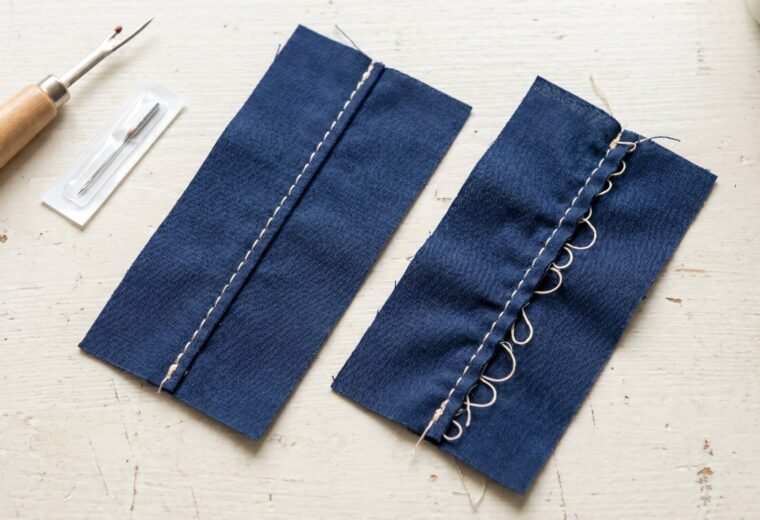
Reading the stitch tells you which direction to move if a dial adjustment is genuinely needed. Loops or loose thread on the underside of the fabric means the top thread is too loose (or more commonly, was never seated in the tension discs at all). Bobbin thread pulling to the top surface of the fabric means the top tension is too tight. Both readings point to the top tension circuit first - rethread before touching the dial.
Here is the Janome-specific part most owners get tripped up on: the bobbin tension drop test does not apply to a top-load Janome. The drop test, where you let a wound bobbin in its case dangle from the thread and watch how it falls, only works on a front-load machine that has a removable bobbin case you can hold in your hand. A drop-in Janome has no separate case to remove. The bobbin sits in a fixed race and its drag comes from a flat tension spring built into the throat-plate cover, so there is nothing to dangle and nothing to turn. That bobbin tension is factory-set and should not need adjusting for normal sewing.
So when the stitch reads tight or loose on a drop-in Janome, the correction lives almost entirely on the top side: rethread the top path with the foot up, fit a fresh needle, confirm the bobbin is seated and routed under its spring, then move the top dial in small steps from the 4 to 5 default. If the stitch still will not balance after all of that, the cover spring is the last suspect, and it is a technician fix. It is thin spring steel held by a tiny screw, and bending it by hand usually snaps it or changes the drag unpredictably. Our full tension guide covers the front-load drop test and every other diagnostic path for when the dial genuinely cannot bring the stitch into balance.
Which Janome models this covers
The drop-in bobbin design runs across the vast majority of Janome's consumer lineup sold in the US. The troubleshooting steps on this page apply fully to drop-in models. Two popular Janome machines - the HD1000 and the 2212 - use a front-loading vertical oscillating hook and different rules apply to them; they are listed below with a clear note.
| Model | Bobbin type | Common complaint | Specific guide |
|---|---|---|---|
| HD3000 | Drop-in (top-load) - rules on this page apply | Feed dog lint buildup, tension drift on canvas | HD3000 problems |
| HD1000 / HD1000 Black Edition | Front-load per Janome.com (vertical oscillating hook, removable bobbin case) - drop-in rules do NOT apply. See front-load rules | Thread bunching on denim, needle breaking at seam intersections | HD1000 problems |
| 2212 | Front-load per Janome (vertical oscillating hook, removable bobbin case) - check whether yours has a case you remove; if so, follow the front-load rules | Skipped stitches on knit, picking up bobbin thread after long break | 2212 problems |
If your machine has a separate bobbin case that you remove to insert the bobbin, it is a front-load machine. The oiling procedure, the bobbin class check, and the tension spring behavior described on this page are specific to drop-in machines and do not transfer. The drop-in vs. front-load explainer shows the physical difference clearly if you are not sure which type you have.
Needle rules that apply to every Janome
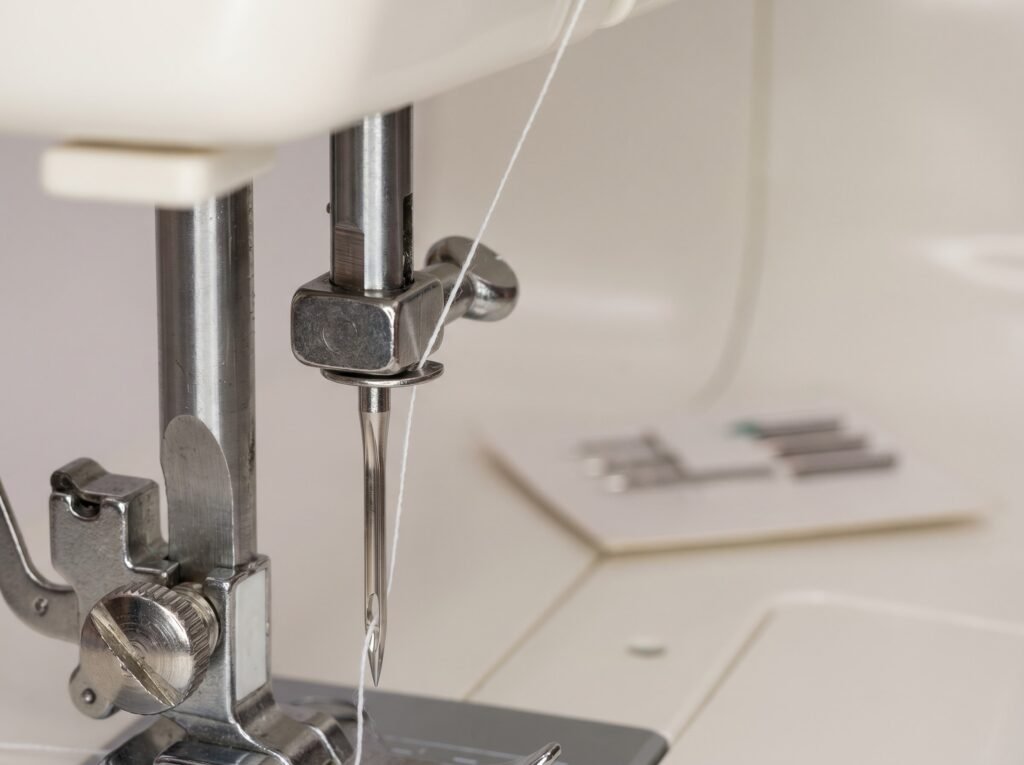
Janome machines use the standard 130/705 H needle system - the same flat-shank system as Singer, Brother, Bernina, and virtually every other home machine sold in the US. Schmetz, Organ, and Klasse needles all fit. Size is expressed in dual notation: the Euro (NM) number followed by the US number, for example 80/12, 90/14, or 100/16.
For everyday cotton and linen, an 80/12 or 90/14 universal works well. Knit and stretch fabric needs a ballpoint or jersey needle (the same 130/705 H system, just a rounded point) to prevent skipped stitches - a universal point deflects the loops of a knit rather than passing cleanly through them. Heavy denim or canvas calls for a 100/16 or 110/18 with a reinforced blade.
Change the needle at the first sign of trouble, and otherwise treat it as a consumable: a fresh one at the start of any new project, or after roughly 8 hours of sewing as a rough rule of thumb. There is no official Janome hour count; the point is that a needle is a couple of dollars and a worn one quietly causes problems. A bent needle is the single most common cause of skipped stitches on any machine, Janome included - the hook times its pass to meet the needle at a specific height, and a bent needle presents that target a fraction of a millimeter off. The hook misses, the loop is not caught, and the result looks like a timing problem when it is simply a two-dollar fix. Our needle guide covers the full sizing and type selector.
Where the DIY line sits on Janome repairs
Threading, needle changes, bobbin cleaning and reseating, lint removal, and adjusting the top tension dial are all within reach for any owner with the machine manual open. So is cleaning the feed dogs and applying that single drop of oil to the wick.
Stop and call a technician when:
- The timing is genuinely off (needle breaks or skips stitches on every fabric, every needle, after a full rethread - and you can see the needle missing the hook on a slow handwheel turn).
- The hook is visibly bent or chipped.
- The machine has an electrical fault - won't power on, foot pedal unresponsive - beyond checking the cord and pedal connections. Internal electrical work is unsafe without proper training; always unplug before any inspection.
- The bobbin area tension spring is broken or bent.
A standard service and tune-up typically runs about $80 to $150 at a certified dealer (a US-market ballpark that varies by region), depending on what the technician finds; computerized models and some premium brands run higher. The simple heuristic: if the quoted repair approaches half the cost of replacing the machine AND it is a basic mechanical model, replace it rather than repair. On a machine that cost under $200 new, a single $100 tune-up plus any parts crosses that line fast, so a routine service still makes sense but a major mechanical repair usually does not. A computerized or heavy-duty machine you paid several hundred for is almost always worth fixing. The repair-vs-replace guide walks through the decision with real numbers so you can make the call with confidence.
For replacement parts - presser feet, bobbin cover plates, needle plates, and feed dog assemblies - Janome keeps a direct parts catalog, and independent suppliers carry Janome-compatible plastic bobbins, presser feet, and throat plates. Our parts sourcing guide explains how to read Janome's part numbers and where to source them without paying dealer markup.
Questions answered
Do all Janome machines use the same bobbin?
Most modern Janome top-load machines use Janome's own plastic bobbin, stamped 'J' on the centre post (J for Janome), which the company describes as a basic Class 15 bobbin. Class 15 and Class 15J bobbins are the same physical size and are generally interchangeable - the J refers to the hook or case style, not a different bobbin dimension. The real incompatibility to watch is Class 15 versus Class 66 (a smaller bobbin used in older Singer-style front-loaders), and metal versus plastic where your machine specifies plastic. Third-party bobbins that are a touch bigger, smaller, or curved can cause uneven drag or jam the race regardless of the class label. Older front-load oscillating-shuttle models use different classes entirely. Match the bobbin spec'd in your specific model manual before ordering rather than buying on looks.
Why does my Janome keep bunching thread under the fabric?
The cause is almost always the top thread, not the bobbin - specifically threading the machine with the presser foot lowered. The tension discs stay closed when the foot is down, so the thread never seats inside them. Raise the foot, remove all thread, rethread completely from scratch, and swap in a fresh needle before adjusting anything else.
Can I use a metal bobbin in my Janome?
No. Janome is explicit that top-load (drop-in) machines take plastic bobbins only, because the race uses a magnet to hold the bobbin holder and that magnet will interfere with a metal bobbin. In practice this is a rare problem, since a metal bobbin does not seat well in a top-load race anyway, but the rule is firm: use only the plastic bobbin specified for your machine's class.
My Janome tension dial is at 4 but stitches are still uneven - what now?
The dial setting is only meaningful if the threading is correct. Rethread the top path completely with the presser foot raised, install a fresh needle, and confirm the bobbin thread is routed through the slot and tension spring on the clear cover. Run a test seam. If tension is still off after those three steps, our tension troubleshooting guide covers the full diagnostic from stitch reading to dial adjustment.
How often should I oil my Janome drop-in machine?
Janome's own guidance is to oil (one drop of sewing machine oil on the felt wick under the bobbin area - not on any other surface) only when the machine sounds noisier than usual, not on a fixed schedule. Check your specific model manual first, because some computerized Janome machines are factory-sealed and require no user oiling at all. Janome also recommends yearly professional servicing regardless of how often you sew.
The Stitchmend team
Every fix here is built from manufacturer service manuals and needle-maker specs, and fact-checked against those sources before it goes live. How we work