Sewing machine needles: how to pick the right one, what the numbers mean, and when to change it
Your complete guide to sewing machine needles: the 130/705 system, dual sizing (90/14), needle types by fabric, when to change, and which brand to buy.
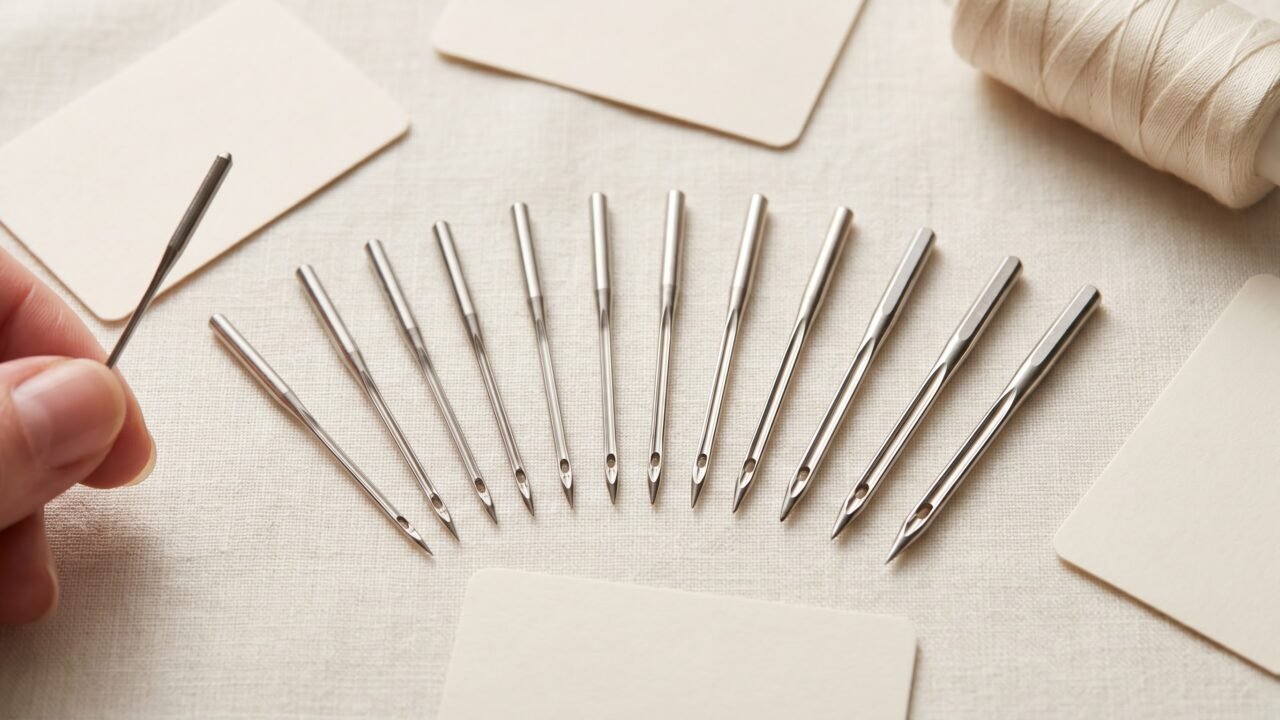
Pick the right needle and your machine behaves. Pick the wrong one and you get skipped stitches, shredded thread, or holes punched through fabric that should glide. Once you understand two things - the needle system your machine uses and how needle size maps to fabric weight - you can solve most needle questions in under a minute.
Every needle question eventually comes down to three decisions: which type of needle, which size, and which brand. The needle guide table below handles all three by fabric and thread. The rest of this guide explains the logic behind it, so you can make the call yourself when the table isn't handy.
One system fits almost every home machine: 130/705 H
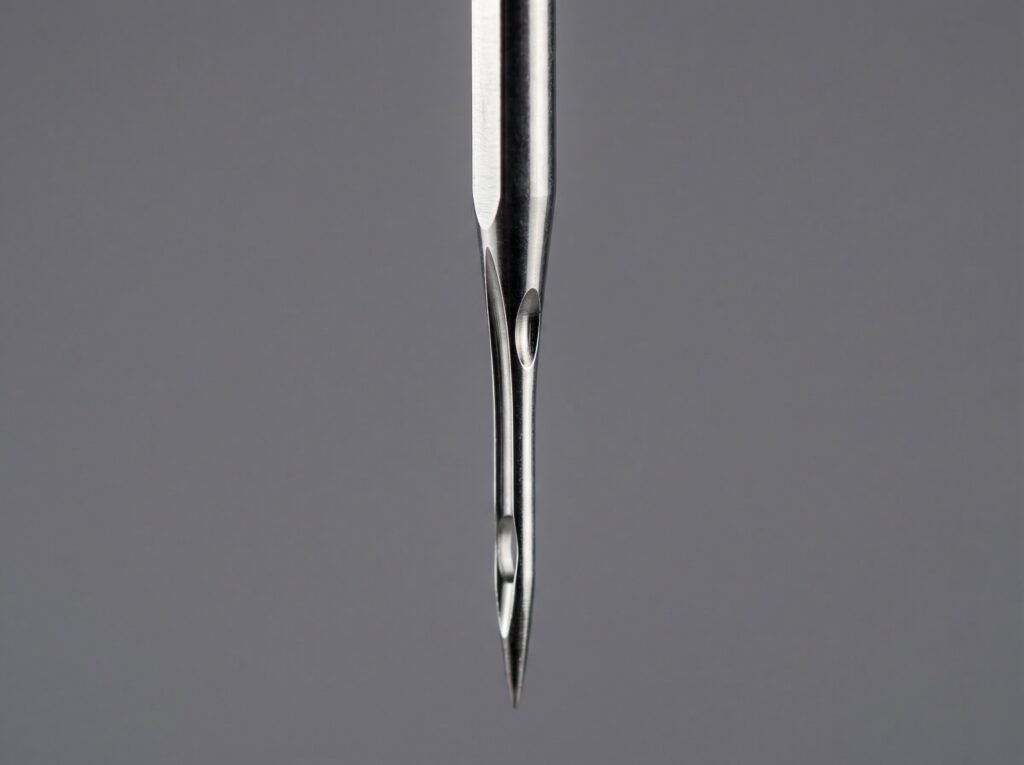
The 130/705 H designation is the international standard for home sewing machine needles. According to Schmetz, 99% of all home sewing machines use this system - including Singer, Brother, Janome, Juki, Pfaff, Bernina, Husqvarna Viking, and Baby Lock. You may also see it labelled HAx1 or 15x1 on older needle cards; these are cross-references for the same needle anatomy, just different manufacturer codes for the same shank shape.
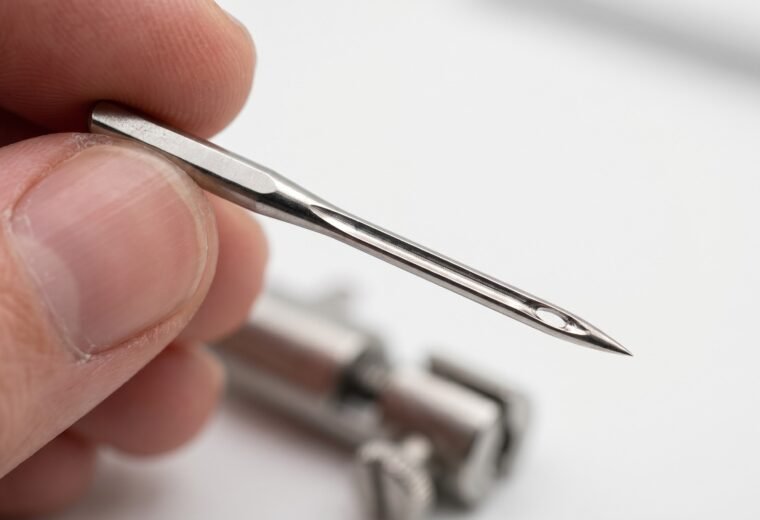
What do those numbers actually mean? The 130/705 pairing is a system designation, not a physical measurement of this needle. According to Schmetz, domestic machines were once sold with two common needle systems, 130 or 705, which differed by the machine's hook or shuttle type; these were later unified into the single 130/705 H standard that home machines use today. The numbers encode system identity, not a dimension. The H is an abbreviation of the German word Hohlkehle - it means "scarf," the small groove cut into the back of the needle shaft just above the eye. That scarf is what lets the hook catch the thread loop cleanly - it is the feature that makes consistent stitch formation possible.
The flat shank is the key physical feature: one side of the needle's upper shaft is ground flat rather than left round. That flat registers against a stop inside the needle clamp so the needle cannot rotate. It also ensures the scarf always lines up with the hook - which is the entire secret of consistent stitch formation. If your needle can spin in the clamp, even slightly, you'll get intermittent skipped stitches that no tension adjustment will fix.
The dual size numbers: what 90/14 (or 80/12, or 100/16) actually tells you
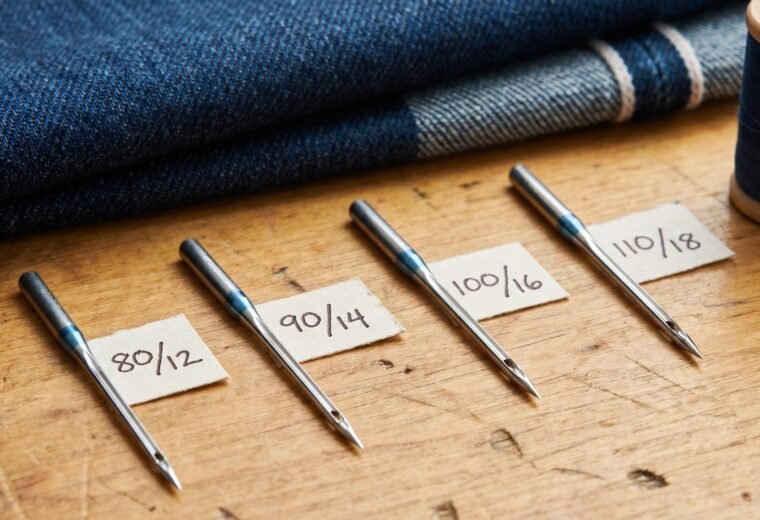
Every needle package shows two numbers separated by a slash. The first is the European metric size; the second is the old Singer US size. A 90/14 needle has a blade diameter of 0.90 mm. An 80/12 blade is 0.80 mm. A 100/16 is 1.00 mm. The European number is the blade diameter multiplied by 100 - a direct physical measurement, not an arbitrary scale.
Why does diameter matter? A finer needle displaces less fabric as it enters. Use too thick a needle on lightweight silk and you'll leave visible holes and possibly pucker the seam. Use too thin a needle on denim and the blade deflects under the force of penetrating the dense weave, which breaks the stitch loop before the hook can catch it - hence skipped stitches and, if severe enough, a broken needle.
The common home-sewing range runs from 60/8 (very delicate sheers) up to 110/18 (heavy canvas or multiple denim layers). A 90/14 universal is the closest thing to a default for mid-weight wovens. The full size-to-fabric mapping is in the needle guide table below.
Needle guide: fabric + weight + thread to exact type and size
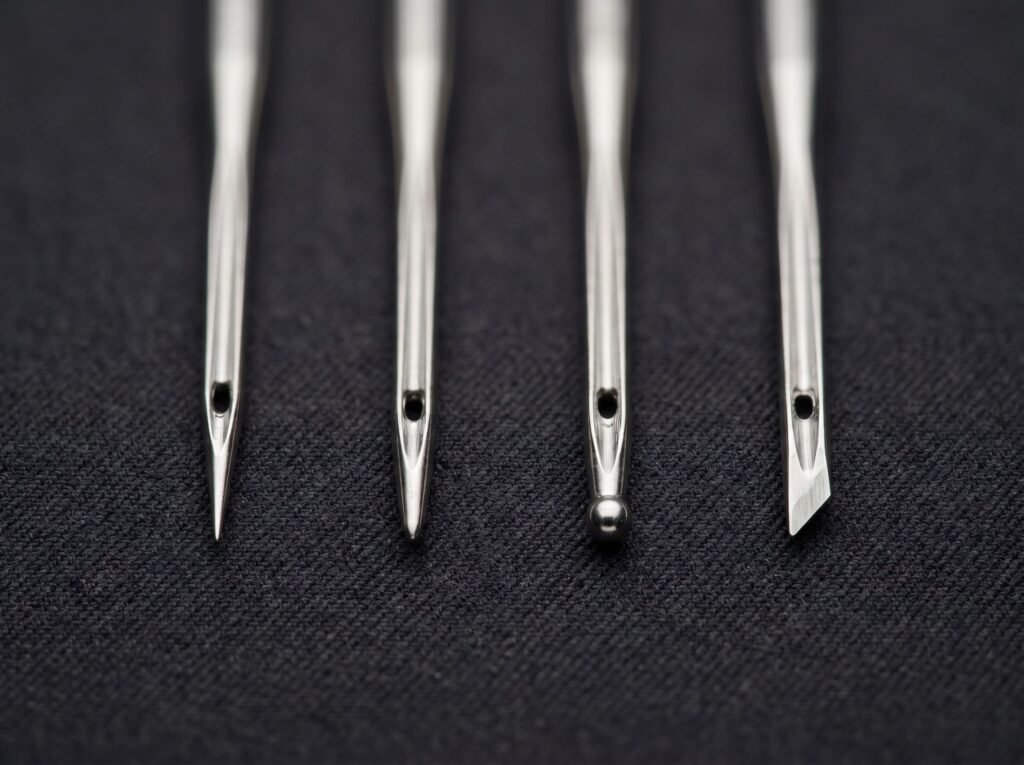
Use the table to find your needle in two steps: identify your fabric category in the left column, then match the weight/texture to the size column on the right. The needle type in the middle column tells you the point geometry you need.
| Fabric / material | Needle type | Size range | Notes |
|---|---|---|---|
| Lightweight wovens (batiste, organza, chiffon, silk) | Microtex/Sharp | 60/8 - 70/10 | Tiny point; avoids snags on delicate weaves |
| Medium wovens (quilting cotton, linen, poplin, taffeta) | Universal | 80/12 - 90/14 | Slight ballpoint handles minor surface texture |
| Heavy wovens (canvas, twill, upholstery) | Universal or Jeans | 100/16 - 110/18 | Jeans needle adds reinforced blade for dense fabric |
| Denim (multiple layers, jeans seams) | Jeans/Denim | 90/14 - 110/18 | Reinforced blade resists deflection; our denim needle guide covers sizing in detail |
| Knit fabrics (jersey, interlock, sweatshirt fleece) | Jersey/Ballpoint | 70/10 - 100/16 | Rounded tip pushes aside fibers instead of piercing them; size up to 100/16 for heavy sweatshirt fleece |
| Stretch / elastic-content fabrics (lycra, spandex, swimwear) | Stretch | 75/11 - 90/14 | Medium ballpoint + deep scarf prevents skipped stitches on high-stretch material |
| Microfiber, coated fabric, vinyl, oilcloth | Microtex/Sharp | 70/10 - 90/14 | Slim point cuts cleanly through tightly woven synthetic weaves |
| Leather, suede, faux leather | Leather | 80/12 - 100/16 | Wedge-shaped cutting tip; do NOT use on wovens or knits (cuts holes) |
| Quilting (multiple layers, cotton batting) | Quilting | 75/11 - 90/14 | Tapered point designed for easy penetration through multiple layers |
| Decorative topstitching with heavy thread | Topstitch | 80/12 - 100/16 | Extra-large eye and large groove prevent heavy thread from shredding; slightly rounded point (not as sharp as Microtex) - switch to Microtex if using on tightly woven delicate fabric |
| Embroidery (rayon or polyester embroidery thread) | Embroidery | 75/11 - 90/14 | Light ballpoint, enlarged eye, wide groove reduce thread stress |
A few practical clarifications. Universal needles work on both wovens and knits because of their slight ballpoint - but on genuine stretch fabric (anything with lycra or a high spandex content), that slight ballpoint is not rounded enough to reliably avoid piercing fibers, so skipped stitches creep in. Use a stretch needle there. The Schmetz needle guide lists jersey/ballpoint needles in sizes 70/10 through 100/16 specifically for cotton knits, bouclé, and lingerie, while stretch needles (65/9 to 90/14) cover elastic, lycra, and high-content spandex blends where stitch skip is the chief risk.
One rule worth flagging on its own: skipped stitches on any knit means the wrong needle type is your first suspect. The single most common cause of skipped stitches on jersey, interlock, rib knit, or sweatshirt fleece is reaching for a universal needle when the job calls for a ballpoint (jersey) or stretch needle. A sharp universal point pierces and severs the looped knit fibers instead of sliding between them, and the severed loop fails to form a clean stitch. Before you touch tension, threading, or timing on a skipped-stitch problem with knits, swap to a jersey or stretch needle.
Thread weight also matters. If you're running a heavy topstitch thread through a standard needle, the eye is too small and the groove too shallow - the thread pinches and shreds on every stitch. Move to a topstitch needle one size up from your normal choice. Conversely, using a 90/14 needle on 60-weight fine machine embroidery thread leaves slop in the eye that allows the thread to shift and cause inconsistent tension.
For a closer look at the differences between needle types and their points, the needle types deep-dive breaks down each point geometry with diagrams. The needle sizes explained article walks through every size increment from 60/8 to 120/19 with specific fabric examples.
Which brand: Schmetz, Organ, or Klasse
All three fit the 130/705 H system. Quality differences between them are minor for standard home sewing. The practical distinctions come down to variety, price, and what your machine's maker specifies.
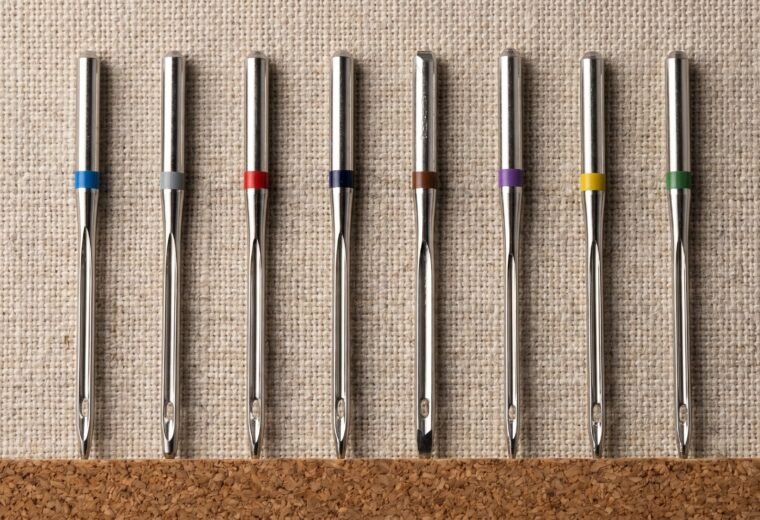
Schmetz (German manufacture) has the widest product range - covering Universal, Denim, Jersey, Stretch, Microtex, Quilting, Embroidery, Topstitch, Leather, Metallic, Wing, Twin, and more - and is the most commonly stocked brand at independent sewing retailers. Their color-coded banding system (upper band for needle type, lower band for size) makes it easy to grab the right needle from a drawer without reading small print.
Organ (Japanese manufacture) is a long-standing OEM needle supplier and is widely used in commercial embroidery machines. For Brother's professional PR-series multi-needle embroidery machines specifically, Brother's official support names the HAX 130 EBBR (Organ) as the factory-recommended needle, with Schmetz 130/705 H-E listed as an approved alternative. That recommendation applies to those professional embroidery machines, not to standard Brother home machines like the CS6000i or XM2701, which simply take ordinary 130/705 H needles in any of the three brands. Organ needles carry a slightly lower street price, and for general home sewing most operators find them interchangeable with Schmetz at any given size.
Klasse (UK-distributed, German manufacture) is comparable in quality to Schmetz and widely available in the UK market. Its range is narrower than Schmetz but covers all the common types.
One caution worth naming: some Singer machines with a tight hook-to-needle clearance have been reported to miss stitches with certain third-party needles - the "won't pick up bobbin thread" symptom. This usually comes down to shank geometry variation or a needle seated too low rather than a genuine brand incompatibility, but if you switch needle brands on a Singer and suddenly lose the bottom thread, recheck seating before blaming the needle. Singer's own branded needles are pre-qualified for their hook geometry. Our comparison of all three brands is in the Schmetz vs Organ vs Klasse guide.
How to install the needle correctly
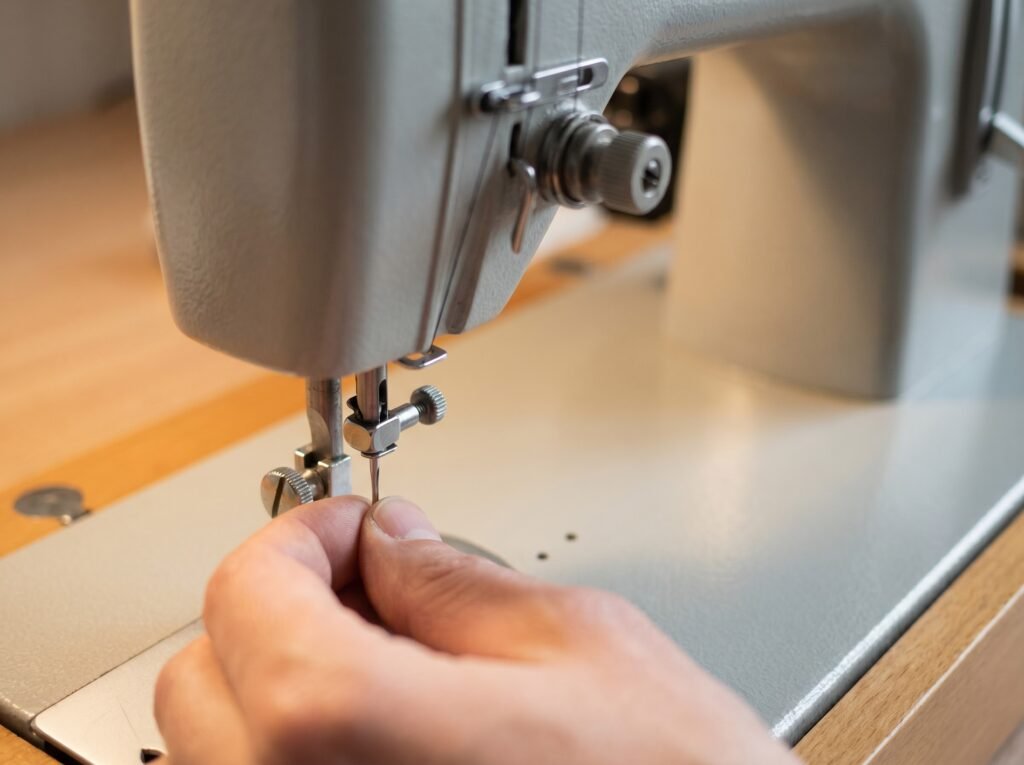
Wrong installation is one of the most common needle-related causes of skipped stitches. Two rules cover 95% of cases.
First: push the needle all the way up. There's a stop pin inside the needle bar. The top of the needle shank must seat against it. If the needle is even 1-2 mm too low, the hook passes the scarf at the wrong point in the travel cycle and misses the thread loop. The clamp screw only needs to be snug - finger-tight plus a quarter turn. Overtightening can distort the clamp or the shank itself.
Second: orient the flat side correctly. On the vast majority of home sewing machines, the flat of the shank faces toward the back of the machine, and the scarf (the groove above the eye) faces the hook. Which side the hook sits on varies by machine - front-loading bobbin machines and drop-in bobbin machines differ, and it is not the same from model to model - so do not assume it is on a particular side. The reliable principle, from the ISMACS orientation guidance, is simply that "the short groove/scarf side of the needle always faces the hook." Your machine's manual will confirm the exact orientation, and a handful of older machines orient the flat to the side rather than the back, so check once if you've inherited a vintage machine.
If you're seeing intermittent skipped stitches after all other checks, remove the needle and re-insert it. It takes about 15 seconds and rules out the most common installation error.
When to change the needle
A needle's point dulls faster than it looks like it should. The rule of thumb from the industry is every 8 hours of active sewing time - not clock time sitting at the machine, but actual stitching. For most home sewers that's roughly one project per needle. On heavy fabric (denim, canvas, multiple layers) the tip blunts faster; change after each project regardless of hours.
Don't wait for a visible bend. A needle can deflect enough to cause skipped stitches while still looking straight to the naked eye. The Schmetz FAQ lists the symptoms clearly: shredded or broken thread, skipped or uneven stitches, fabric puckering, unusually large stitch holes, or a popping/clicking sound as the needle enters the fabric. Any of those is a signal to swap the needle before adjusting anything else.
Needles are inexpensive. A five-pack of 90/14 universals costs under $4. If you're deep in a project and something suddenly goes wrong with the stitch, a fresh needle is always the first fix to try - it costs almost nothing and clears the problem a large share of the time.
That is the logic of starting with the cheap fix: on a skipped-stitch problem the needle is the culprit roughly nine times out of ten - it is bent, dull, the wrong type, the wrong size, or installed wrong. Work the causes in that order: needle first, then threading (rethread top and bobbin from scratch), and only then suspect machine timing, which is last on the list and the rare case that genuinely needs a technician. The skipped stitches guide walks through that full ranked sequence, and when to see a pro covers the point at which paying for a repair makes sense.
Frequently asked questions
Can I use the same needle brand in any home sewing machine?
Almost always yes, since all 130/705 H needles share the same shank dimensions. The practical exception is certain Brother professional multi-needle embroidery machines (specifically Brother's professional multi-needle PR-series machines, not standard home models like the CS6000i or XM2701), where Brother officially specifies Organ HAX 130 EBBR needles and notes that other needles "may break the needle or thread or damage the needle-threading mechanism." For standard home sewing, Schmetz, Organ, and Klasse are interchangeable in the 130/705 system across virtually all brands.
My machine manual says to use "HAx1" needles. Is that the same as 130/705?
Yes, exactly the same needle. HAx1, 130/705 H, and 15x1 are three codes for the same flat-shank home machine needle standard. Different manufacturers use different code systems, but the physical needle is identical.
Do I need a special needle for a twin needle?
Twin needles use two blades on a single shared shank - still the 130/705 system. One thing trips people up at the shop counter: twin needles are labelled with a third kind of number you will not see on a single needle, written as something like 4.0/80. The first figure is not a size in the usual sense - it is the spacing between the two needles in millimeters (4.0 mm here), and the second figure is the ordinary metric needle size (80, a 0.80 mm blade). Per Schmetz, the first number is the distance between the two needles and the second is the needle size, so a 2.0/80 sews two rows closer together than a 4.0/80 does. (Some packages and shops flip the order and print it as 80/4.0; the millimeter value with the decimal point is always the spacing.) The wider the spacing, the more important the next part: twin needles require a needle plate with a wide enough aperture (the standard zigzag plate). The combined stitch width must not exceed the aperture width, or both needles will strike the plate and break. Never run a twin needle on a stitch that swings wider than the plate allows; test it by turning the handwheel by hand for a full stitch cycle before you touch the foot pedal.
What needle for fleece?
A 90/14 universal works on most fleece because it has enough of a ballpoint to avoid snagging the loops. For a very stretchy athletic fleece with a high spandex content, step up to a stretch needle in the same size to prevent skipped stitches on the elastic fibers.
Why does my needle keep breaking?
Needle breakage is almost always one of four things: the needle is seated too low, the needle is the wrong size for the fabric thickness, the presser foot is not appropriate for the stitch being sewn, or the fabric is being pulled through by hand rather than guided. Our needle breaking guide covers each cause in ranked order with the fix for each.
The Stitchmend team compiled this guide from Schmetz technical specifications, the Schmetz needle-fabric recommendations chart, and Brother USA official support documentation, cross-checked and edited before publishing.
- Schmetz NeedlesFAQ
- Schmetz NeedlesNeedle & Fabric Recommendations
- Schmetz NeedlesNeedle Guide and Jersey/Ball Point product page
- Brother USA Official Support
- ISMACS (International Sewing Machine Collectors' Society)
The Stitchmend team
Every fix here is built from manufacturer service manuals and needle-maker specs, and fact-checked against those sources before it goes live. How we work