Best needle for denim and heavy fabric: pick the right type and size before you sew a single stitch
Denim and canvas demand a jeans/denim needle, not a universal. Pick the right size (90/14 to 110/18) by fabric weight and layers. Full guide from the Stitchmend team.
Pull that universal needle out of your machine before you sew another inch of denim. It is the single most common reason denim stitching skips, pops, or jams - and swapping in a proper jeans/denim needle is one of the cheapest fixes in sewing. Here is the complete rundown on which needle to choose, which size matches your fabric, how to pair it with thread, and one low-tech trick that fixes skipped stitches over thick hem seams.
Why a jeans/denim needle and not a universal
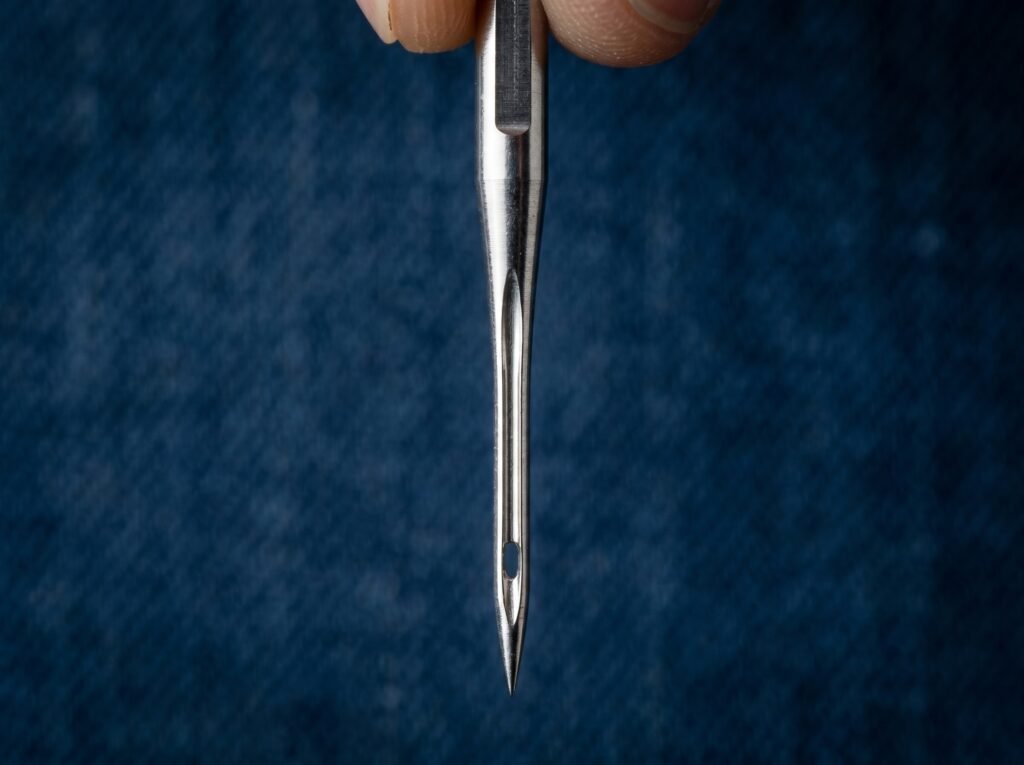
Denim is a densely woven twill, and canvas is denser still. A standard universal needle has a slightly rounded point that was designed to slip between woven threads without piercing them. On a tightly packed fabric like denim, that rounded tip deflects sideways instead of pushing cleanly through - and deflection leads to two things: skipped stitches and a bent or broken needle.
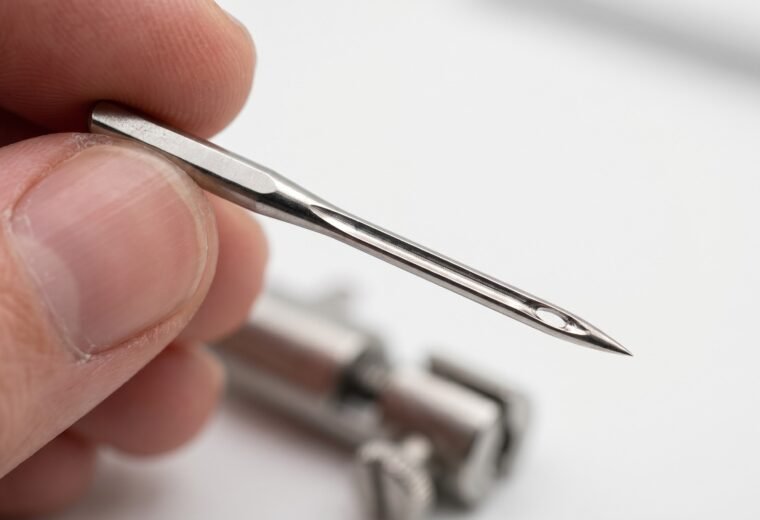
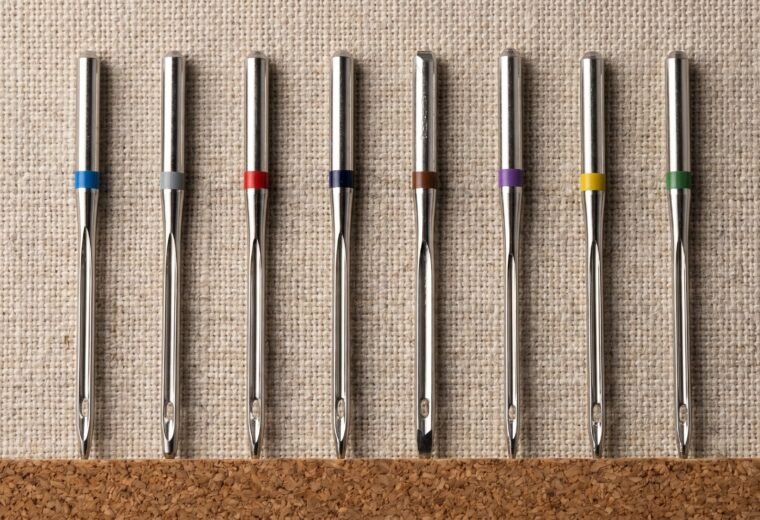
A jeans/denim needle (Schmetz system code 130/705 H-J) is built differently on two counts. First, the point is a modified medium ball point - sharper than a universal tip but not as aggressive as a sharp/microtex. It enters the weave cleanly at the interlacing point rather than forcing its way through the fibers. Second, the blade is reinforced. Thicker shank, stiffer shaft, more resistance to lateral deflection when the needle is pushing through multiple layers at a side seam or waistband. Schmetz describes the design as intended for "penetrating extra thick woven fabrics, denims, or quilts with minimum needle deflection, reduced risk of needle breakage and skipped stitches."
Universal needles are not wrong for denim in every situation - a single layer of 6 oz chambray will behave. But once you are dealing with standard jeans-weight fabric (10 oz and up), or any seam where two or more layers cross, a denim needle stops being a nice-to-have and becomes the only sensible choice. Our needle types guide covers the full family if you want to see how jeans needles compare to sharp, ballpoint, and stretch.
Matching size to fabric: the 90/14 - 100/16 - 110/18 ladder
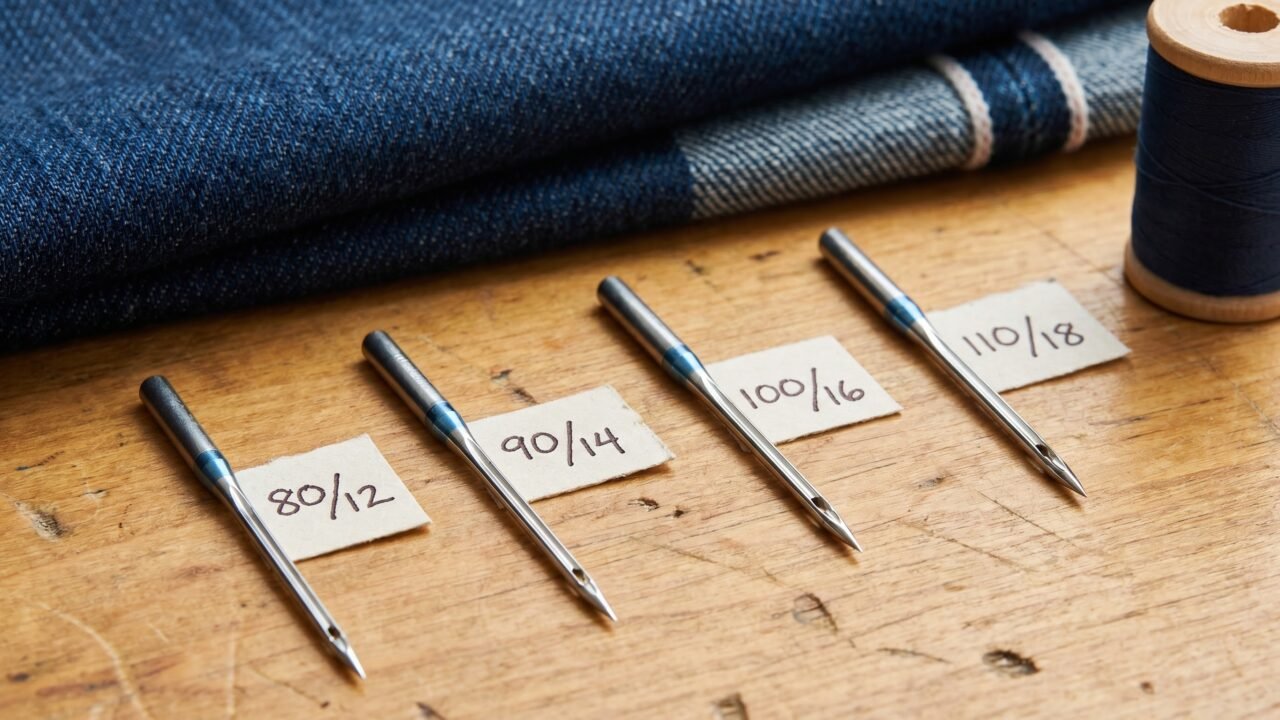
The dual-notation sizing system (Euro metric / American) is straightforward: the metric number is the blade diameter in hundredths of a millimeter, so a 90/14 needle is 0.90 mm across and a 110/18 is 1.10 mm across. Bigger diameter means more resistance to bending, a larger needle hole, and a need for heavier thread to fill it.
The table below is the decision tool. Match your fabric description to the Size column, then confirm your thread weight lands in the Thread column before you thread the machine.
| Fabric / scenario | Denim weight (approx.) | Needle size | Thread weight (top) | Notes |
|---|---|---|---|---|
| Light denim, chambray, denim shirting | 6-8 oz | 90/14 | 50-60 wt polyester or cotton | 90/14 is the right starting point even for lighter denim; 80/12 is too light for any denim fabric |
| Standard jeans denim (most commercial jeans fabric) | 9-12 oz | 90/14 | 50 wt polyester or 40-50 wt cotton | Default starting point for everyday denim projects |
| Midweight to heavyweight denim, canvas, duck cloth | 12-14 oz | 100/16 | 40 wt polyester, 30-40 wt cotton blend | Singer specifies 100/16 for "heavyweight or layered fabrics" |
| Heavy selvedge denim, workwear canvas, multi-layer waistbands, hem bulge (4-8 layers) | 14+ oz or stacked layers | 110/18 | 30-40 wt topstitching thread (top); 50 wt standard bobbin | Also appropriate when 100/16 is still skipping at thick intersections |
| Topstitching with a heavy decorative thread | Any jeans weight | 100/16 or 110/18 | 30 wt topstitching thread | Large eye accommodates thick thread; use standard 50 wt in bobbin |
Two points the table cannot capture on its own. First, layers compound the effective fabric weight. Four layers of 10 oz denim at a side seam behave like 40 oz at that single point - jump a size when crossing those seams rather than insisting on the size that works on flat fabric. Second, when a needle is still skipping after you have upgraded the size, the culprit is almost always a threading problem or a needle installed incorrectly. Our article on skipped stitches covers the full diagnosis, but the first check is always: flat of the shank toward the back (verify in your machine's manual - a small number of models differ), needle pushed all the way up until it seats against the needle bar stopper.
All three major jeans needle brands - Schmetz, Organ, and Klasse - use the 130/705 system and fit any home machine that accepts standard flat-shank needles. Schmetz carries the widest size ladder including an 80/12 and 70/10 for lighter denim. Organ is slightly cheaper and is the brand Brother bundles with machines; Klasse offers the same system with a 6-pack count. Our Schmetz vs Organ vs Klasse comparison breaks down the differences if you are picking a brand.
Thread pairing: the needle size sets the floor
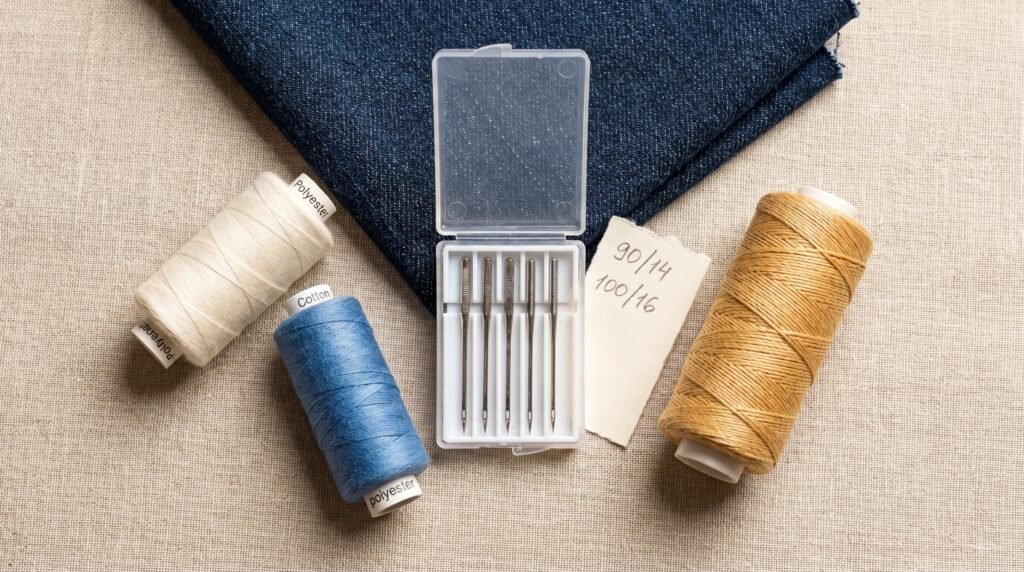
A needle too small for its thread is a setup for shredding. The rule from Schmetz's own guidance: "the heavier jeans threads work best with the larger needle." In practice, this means the thread weight and needle size have to climb the ladder together.
For flat seams on standard 10-12 oz jeans, a 50 wt polyester or 40-50 wt cotton thread through a 90/14 is the workhorse combination. Brother's fabric/needle chart specifically lists 60 wt polyester or 30-50 wt cotton for denim and canvas at sizes 90/14 to 100/16, with a stitch length of 2.5 to 4.0 mm.
Topstitching changes the equation. The authentic jeans-topstitch look requires a heavier thread - typically 30-40 wt - and that demands a larger eye. A 30 wt topstitching thread gives a bold, visible line; a 40 wt reads more subtly. Either needs a 100/16 or 110/18 to avoid the thread dragging through the eye and fraying. Keep the bobbin at standard 50 wt; only the top thread shows on the right side of a topstitch. Stitch length for denim topstitching: 3.0 to 4.0 mm per Janome's guidance - shorter than that and the stitches sink into the weave, losing the classic look.
One more thread note: cotton-wrapped polyester blends are popular for jeans work. In our experience, the cotton surface tends to soften over repeated washes alongside the denim, helping the stitchline blend into aged fabric rather than sitting proud of it - though results vary by brand and wash conditions. Pure polyester holds its color longer and is stronger, but can look slightly synthetic against aged denim. Both are solid options when you match them to the correct weight for your needle. See our broader needles hub for more on thread-needle pairings across fabric types.
The hump-jumper fix for hem bulges and thick seams
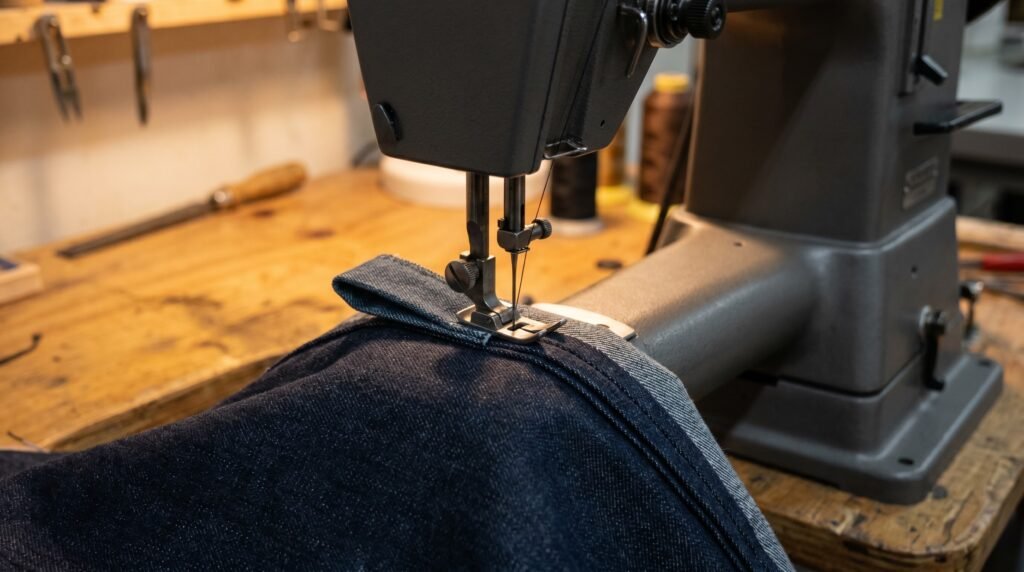
Jeans hems are the single most skipped-stitch-prone moment in denim sewing. You are crossing four to eight layers of fabric at the side seam, and your presser foot tilts forward as it climbs onto the stack - the needle hits the fabric at an angle, deflects, and misses the bobbin hook. Every manufacturer has a version of the same fix.
Janome calls it a hump jumper: a small wedge-shaped tool you slide behind the presser foot to keep it level as it crosses the seam hump. The DIY version costs nothing. Fold a scrap of matching denim (or fold a strip of card stock) to roughly the same height as the seam stack and tuck it under the heel of the presser foot just before the needle reaches the bulge. Brother's official tip for thick fabric seams says the same thing: place material of "the same thickness as the fabric being sewn under the heel of the presser foot to be able to start sewing smoothly."
Two additional moves that help at a hem bulge. First, slow way down - one stitch at a time using the handwheel if needed at the crossing point. Second, use the largest needle that is still appropriate for the fabric weight (a 100/16 or 110/18). Singer's hem-jeans guidance specifically recommends a "denim size 16 or size 18 needle" for jeans hemming - the stiffer blade deflects less at the critical moment. If the machine still struggles after all of this, the issue may be deeper in the feed system; our fabric not feeding article covers the feed-dog and presser-foot-pressure checks.
How often to change a denim needle
Denim dulls needles faster than most fabrics. Singer's guidance is to change every 8-10 hours of sewing time or at the start of each new project. On heavy selvedge or canvas work, where the needle is hitting a significantly denser weave, change more often - the first sign of skipped stitches or a faint "pop" sound as the needle enters the fabric means the point has gone dull or developed a microscopic burr.
A dull needle on denim does not just cause skipped stitches. It deflects more, which increases the chance of bending, and a bent needle on a thick seam can snap. Our article on needle keeps breaking walks through the break-location diagnosis if you are dealing with that problem alongside the denim work.
For denim specifically: start every garment with a fresh needle, not just every project session. Jeans have enough dense seam crossings that a tired needle mid-garment is a genuine risk. The cost of one needle is trivial against the frustration of chasing skipped stitches through a nearly finished pair.
Our pick
For most home sewers cutting standard jeans-weight denim (9-12 oz), the Schmetz Jeans/Denim needle in size 90/14 is the right starting needle. Move to 100/16 for heavier fabric, canvas, or visible topstitching. Keep one 110/18 in the pack for waistband and hem crossings on thick selvedge work. All three are 130/705 H-J, all three fit any standard flat-shank home machine.
If you prefer a two-size assortment pack over buying individually, the Schmetz assorted jeans pack (90/14, 100/16, 110/18) covers the full weight range in one box. For brand comparison details, our needle sizes explained guide goes into the sizing system further, and the brand comparison breaks down value and availability.
Questions answered
Can I use a universal needle for denim if I do not have a jeans needle?
If you are mid-project and a jeans needle is not on hand, a universal 90/14 can limp you through a single layer of lightweight chambray (under 8 oz) - enough to finish a seam and then swap the needle before you continue. On standard jeans fabric (10 oz and up), or anywhere two or more layers stack, a universal tip deflects on the tight weave and causes skipped stitches or needle breakage. A pack of jeans needles costs under $5 and eliminates the problem at the root; it is worth keeping a spare pack in your sewing kit so you are never caught short mid-project.
What size needle for hemming thick jeans?
Singer's official hemming guide specifies a size 16 (100/16) or size 18 (110/18) denim needle for jeans hemming. Use the hump-jumper trick - a folded scrap of denim under the presser-foot heel - to keep the foot level crossing the side-seam bulge, and sew slowly at the thickest point.
Will a jeans needle damage lighter denim or shirting fabric?
A 90/14 jeans needle on lighter denim shirting is the right call. The point is only slightly more assertive than a universal at that size, and the reinforced blade causes no harm on light fabric. Problems would only appear if you used a 110/18 on very thin fabric - the hole would be visibly oversized. An 80/12 is too light for any denim, even shirting weight.
Should I use a topstitching needle or a jeans needle for decorative denim topstitching?
Both work. A topstitching needle has a larger eye specifically sized for heavy decorative thread. A jeans needle at 100/16 or 110/18 also has an eye large enough for 30-40 wt thread and adds the reinforced blade advantage on thick layers. For most denim topstitching, a 100/16 jeans needle paired with 30-40 wt thread is the simpler choice.
- Schmetz Needles (via Euro-notions needle descriptions)
- SingerChoosing the Right SINGER Machine Needles
- Brother USA SupportFabric/Thread/Needle combination chart (CP100X)
- JanomeTopstitching Tips and Tricks on the HD9
- SingerHow do I Hem Jeans?
The Stitchmend team
Every fix here is built from manufacturer service manuals and needle-maker specs, and fact-checked against those sources before it goes live. How we work