Sewing machine needle types: what each point, eye, and scarf is built for
Match needle type to fabric, not just size. Universal, ballpoint, jersey, stretch, denim, leather, microtex, quilting, topstitch - each explained with when to reach for it.
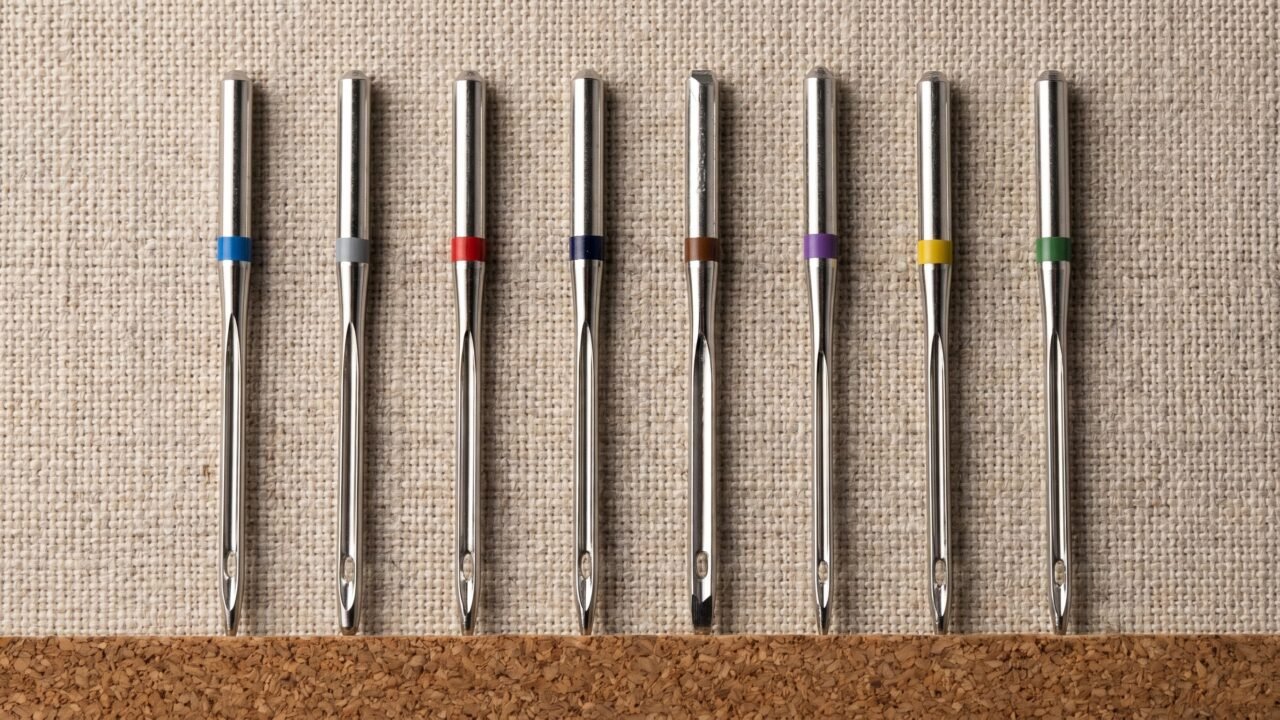
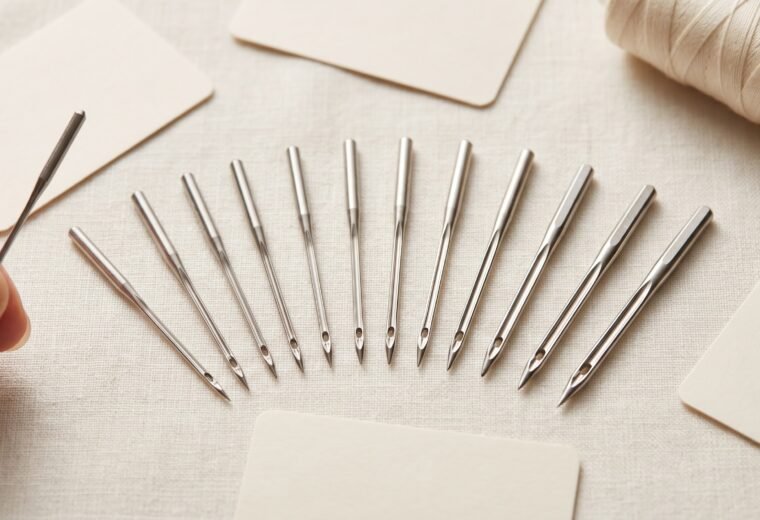
Pull a needle from a new pack and it looks identical to every other needle in your drawer. Same length, same flat shank, same silver finish. But the tip geometry, the eye shape, and the scarf depth above that eye are all different - and those three differences are exactly what determines whether your stitch forms cleanly or skips, snags, or shreds the fabric. Every needle in the 130/705 H system fits any home sewing machine, but fitting the machine and doing the job right are two separate things.
Eight types cover nearly every project a home sewer encounters. This guide explains what each one is built for, why it works on its intended fabric, and which scenario calls for a swap.
The three features that make needle types different
Before running through the types, it helps to know which parts of the needle actually change. The needles hub covers full anatomy, but three elements drive type-to-fabric matching.
The point and tip is the first area of the needle to enter the fabric. Schmetz describes it plainly: "The point and tip length, shape, and size vary according to needle type." A rounded point pushes threads aside; a sharp point pierces them; a cutting (chisel) point slices a hole.
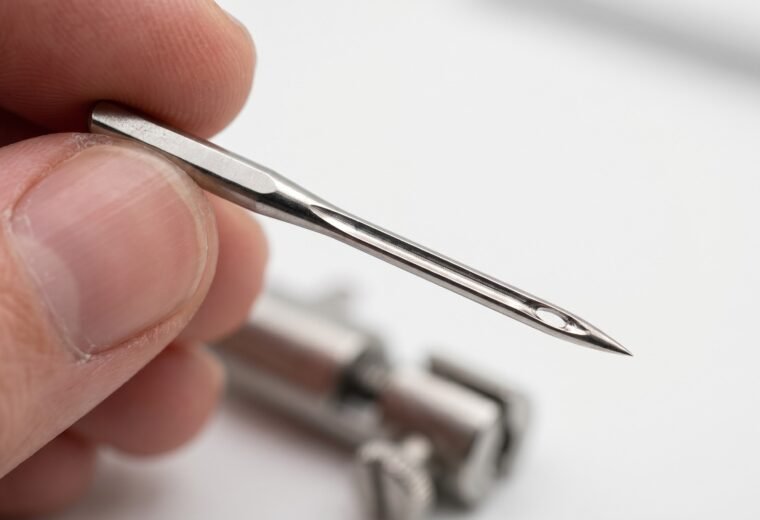
The scarf is the indentation on the back of the needle just above the eye. Its job, per Schmetz's needle anatomy guide, is allowing "the bobbin hook to smoothly grab the thread under the throat plate to create a stitch." A deeper scarf gives the hook a larger window to catch the loop - critical on stretch fabrics where timing between needle and hook has less room for error.
The eye varies in size and shape. A long, narrow groove above the eye (the front groove) cradles thread and reduces friction on the way to stitch formation. Needle types with heavier thread demands get a larger, sometimes elongated eye to reduce shredding.
Universal: the everyday default
The Universal is on most machines from the factory and handles the widest range of jobs. Schmetz describes it as "the most popular, all-purpose needle type" with "a slightly rounded point" that "sews woven and knit fabrics."
That slight rounding is a deliberate compromise. On wovens, the point still penetrates cleanly enough to produce a neat stitch. On stable knits - plain jersey, cotton-lycra blends at lighter weights - the rounded tip nudges threads aside rather than piercing them, reducing snags. Singer's needle guide calls the Universal (Style 2020) suitable for "all woven fabrics," with the ball point as the specific knit recommendation.
Where universals fall short: highly elastic knits, very fine silks, and anything dense enough to deflect the needle mid-penetration. If you're getting skipped stitches on stretchy fabric, a jersey or stretch needle is the fix - the universal's point is not rounded enough to reliably push aside the elastic fibers without occasionally catching.
Most common sizes: 70/10, 80/12, 90/14, 100/16. Schmetz also produces 60/8 and 75/11 in this type, so the full retail range is wider than the four most-stocked sizes. The number before the slash is the blade diameter in hundredths of a millimeter; the number after is the American size. For more on sizing logic, the needle sizes guide has the full fabric-weight reference.
Ballpoint and jersey: the knit specialist
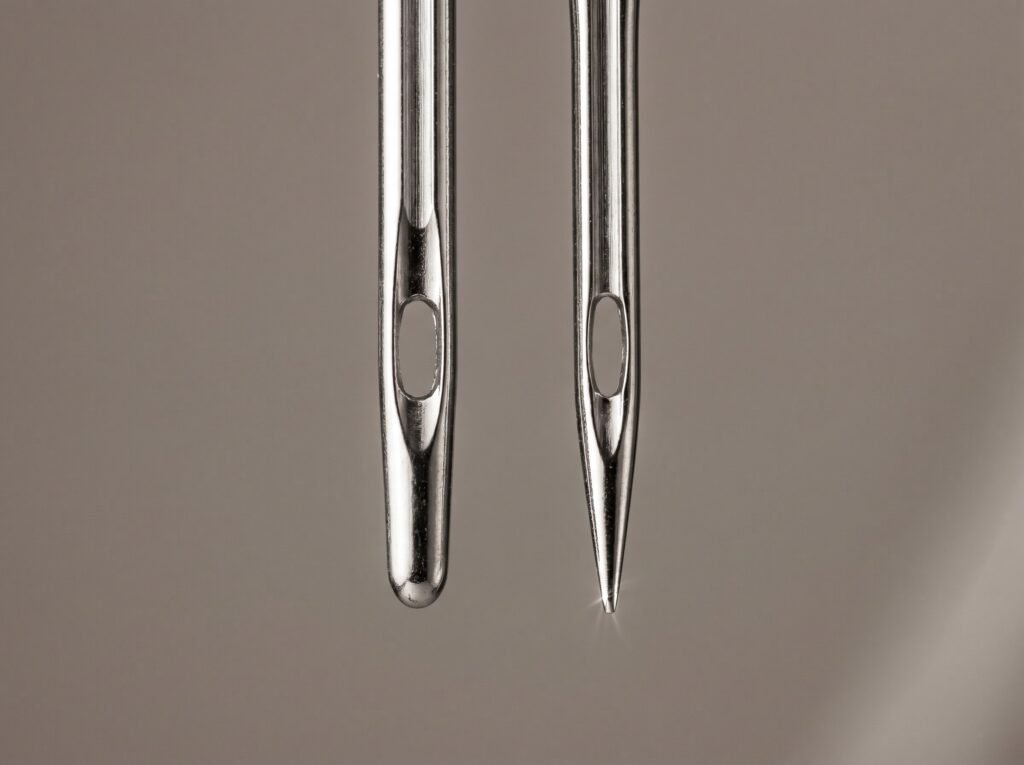
Jersey and ballpoint needles are the same essential design - a round, blunt tip - and Schmetz sells them under the combined name Jersey (Ball Point). The rounded tip does something a sharp point cannot: it pushes knit fibers apart as the needle descends rather than punching through them. Klasse's needle guide describes it as "designed to push the fabric fibres apart rather than cutting them," making it "ideal for cotton knits, interlock, rib knits, fleece, double knit."
Singer's ball point (Style 2045) carries the same logic: "the rounded tip allows the needle to pass between the fabric threads." When threads are spared, they spring back around the thread loop and hold the stitch. When a universal or sharp point pierces knit fibers, small splits accumulate and the fabric eventually ladders.
Why does the ballpoint stop skipped stitches on knits? Stretchy fabric can push back against a descending sharp needle, causing the needle to deflect slightly and arrive at the hook slightly out of position - enough that the bobbin hook misses the loop. The rounded tip meets less resistance, the needle tracks straighter, and the hook catches reliably.
Brother's support documentation for stretch-fabric sewing recommends the ball point (Organ HG-4BR or Schmetz Jersey Ball Point 130/705H SUK 90/14 as a substitute) specifically because "skipped stitches easily occur" on these fabrics without it.
Use a ballpoint/jersey for: lightweight and medium jersey, cotton-lycra blends under moderate stretch, ribbing, fleece, interlock, sweatshirt fabric. For highly elastic fabric with Spandex or Lycra, the stretch needle below handles it better.
Stretch: for elastic and Spandex-heavy fabric
The stretch needle looks similar to the ballpoint but has three engineering differences that matter on fabric with real give: a medium ball point, a smaller eye, and - most importantly - a deeper scarf.
Schmetz is specific: "The SCHMETZ Stretch needle has a medium ball point, a smaller eye, and a deep scarf." Klasse adds that the needle has "a specially designed scarf which prevents skipped stitches." That deep scarf means the bobbin hook has an extended opportunity to catch the thread loop even as the elastic fabric pulls the needle slightly off its ideal line of descent.
The stretch needle is the right call for Lycra, Spandex, power net, silk jersey, swimwear fabric, and anything with elastic fibers woven in. If your jersey projects are skipping with a ballpoint, moving to a stretch needle is the next step before concluding there is a machine problem.
Available in 75/11 and 90/14. The 75/11 handles fine swimwear and lingerie fabric; the 90/14 works for thicker stretch fabrics and elastic.
Denim/jeans: built for resistance
Denim is tightly woven, dense, and puts serious compressive force on the needle during penetration. A universal needle on heavy denim works - until it bends and breaks. The denim/jeans needle is purpose-built to hold up: Klasse describes it as having "a very sharp point" and "a stiffer shank for deflection resistance," designed for "denim fabrics, heavy twill, workwear, and other densely woven fabrics." Singer's Style 2026 is recommended specifically for "denim, jeans, and canvas."
The sharp point slices cleanly through tightly packed fibers rather than pushing them. The stiffer shank resists the sideways deflection that causes needle breakage when crossing thick seam intersections.
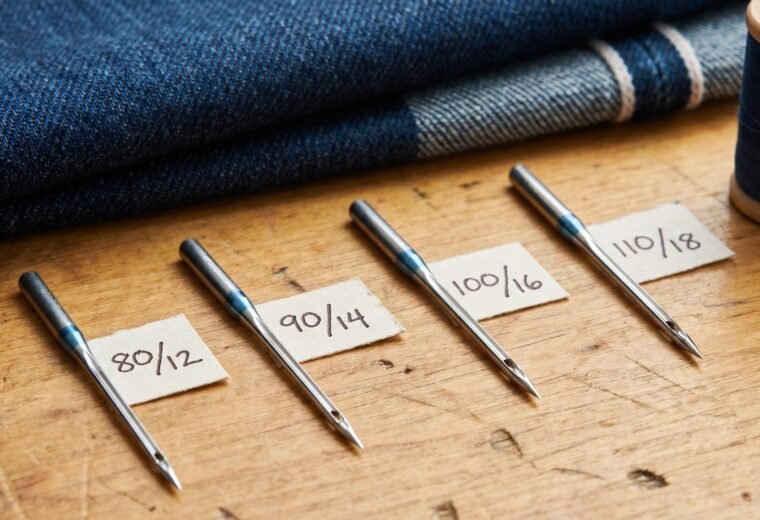
Size selection matters here more than on almost any other fabric type. A 90/14 handles single-layer light denim. Two or three layers of standard jeans-weight denim needs a 100/16. Four layers or heavier canvas calls for a 110/18. Pushing a 90/14 through four denim layers is a reliable way to break it. The best needles for denim guide covers size-to-layer count in detail, including which brands perform best on densely woven workwear.
A common mistake: using the denim needle on all woven fabrics after discovering it handles denim well. The very sharp tip that works for denim can cause runs or pulls in finer wovens like lawn, voile, or silk. Keep it specifically for dense, tight-weave fabrics.
Leather: the cutting-point exception
Leather is the one common sewing material that genuinely needs a different point geometry. Klasse describes the leather needle as having "a cutting point (chisel point design)" that "acts as a chisel in motion." Instead of pushing fibers aside or piercing between them, it cuts a clean slot in the hide on the way through.
Singer's Leather (Style 2032) is listed for "leather and vinyl." The key rule for this needle - stated clearly in Klasse's guidance - is what it is not for: "Not suitable for ultra suede, synthetic suede, or PU imitation leather." On faux-suede or PU fabrics, the cutting point punches holes that tear out under stress because those materials rely on bonded fibers, not a hide structure that holds a cut cleanly.
Two more important limits. First, leather needles should not be used on fabric - the chisel point will cut fibers rather than penetrate cleanly, weakening the cloth. Second, each penetration into leather is permanent; test on a scrap and plan seams carefully, since unpicking leaves visible holes.
If your needle keeps breaking or the thread keeps shredding on leather, the cause is almost never the needle type and almost always the combination of thread weight, needle size, or sewing speed. The needle keeps breaking guide covers the diagnostic sequence.
Microtex (sharp): precision on fine and densely woven fabric
The Microtex, also sold as "Sharp" by most brands, has a straight, acute point that is distinctly sharper than the universal. Klasse's guide specifies a "sharp point" with a "strengthened shaft reducing deflections," suited for "silks, microfiber fabrics, densely woven materials, quilting projects."
Where it earns its name is on fine, tightly woven fabric where any needle deflection shows as a puckered or wavy seam. Silk charmeuse, microfiber, tightly woven cotton poplin, heirloom batiste - these all benefit from the acute tip because it enters cleanly without pushing threads sideways. Klasse also notes the microtex "produces smooth buttonholes" on fine fabric, where a slightly off-center needle hole leaves a ragged edge.
The distinction between microtex and denim: both have a sharp point, but the microtex blade is not reinforced for thick-fabric resistance - it is optimized for precision on fine and medium-weight fabric. Running a microtex through denim is a good way to bend it.
Schmetz produces Microtex (Sharp) in 60/8, 70/10, 80/12, 90/14, and 100/16. The 100/16 is the largest standard retail size in this range - the 110/18 does not exist in Schmetz's Microtex line. The 60/8 handles extremely delicate sheers; the 90/14 works for microfiber suiting. Most quilters using the microtex for fine piecing reach for 70/10 or 80/12.
Quilting: through layers without deflecting
Multiple layers of cotton plus a batting layer create a stacking problem for the needle: each layer can push the needle slightly off axis, and by the time it reaches the bottom of the sandwich, the hook may miss the loop entirely. Schmetz engineered the quilting needle specifically for this: it has a "Slightly Rounded, Special Taper Point" and is "Specifically designed for piecing, patchwork, and machine quilting."
Klasse describes the quilting needle as having a "strengthened longer shaft" that is "ideal for piercing and quilting layers of cotton fabrics and batting." The tapered point design slips through the tight intersections at seam junctions in pieced blocks - points where multiple layers of cotton converge - with less resistance than a universal or microtex tip.
It is not, however, a replacement for the microtex on fine single-layer piecing work where precision is the priority. The quilting needle is optimized for layers; the microtex is optimized for precision on flat fabric.
Available in 75/11 and 90/14. Most quilters use 75/11 for standard cotton quilting fabric (muslin, quilting cottons, batiks) and 90/14 for heavier cotton or when going through a thick batting like 80/20 cotton/polyester.
Topstitch: for thick and decorative thread
Topstitching thread is heavier than standard thread - sometimes much heavier - and standard needle eyes create friction and shredding as the thread passes through at speed. The topstitch needle addresses this directly. Schmetz's description: it has an "elongated eye providing less stress on the thread as it passes through the eye" and is "useful for sewing with metallic, heavy, multiple and even poor-quality threads." Schmetz classifies the topstitch needle's point as "slightly rounded" - the same category as the Universal. Klasse describes theirs differently, specifying an "extra large eye" with an "extra sharp point," so the two brands genuinely differ on point geometry.
The elongated eye reduces friction as the thread passes through at speed, so heavier threads stay intact instead of fraying at that contact point. The sharp point (on Klasse) or slightly rounded point (on Schmetz) gives clean entry into the fabric that will carry the topstitching thread's wider stitch footprint.
Topstitch needles work on any fabric type - the choice is driven by the thread, not the fabric. Use one whenever you are working with topstitching thread, buttonhole twist, 30-weight decorative thread, or metallic thread. The one variable to watch is needle size: the eye needs to match the thread weight. A 90/14 topstitch handles standard 40-weight topstitch thread; heavier 30-weight or 12-weight decorative thread needs a 100/16 or 110/18.
Quick-reference type selector
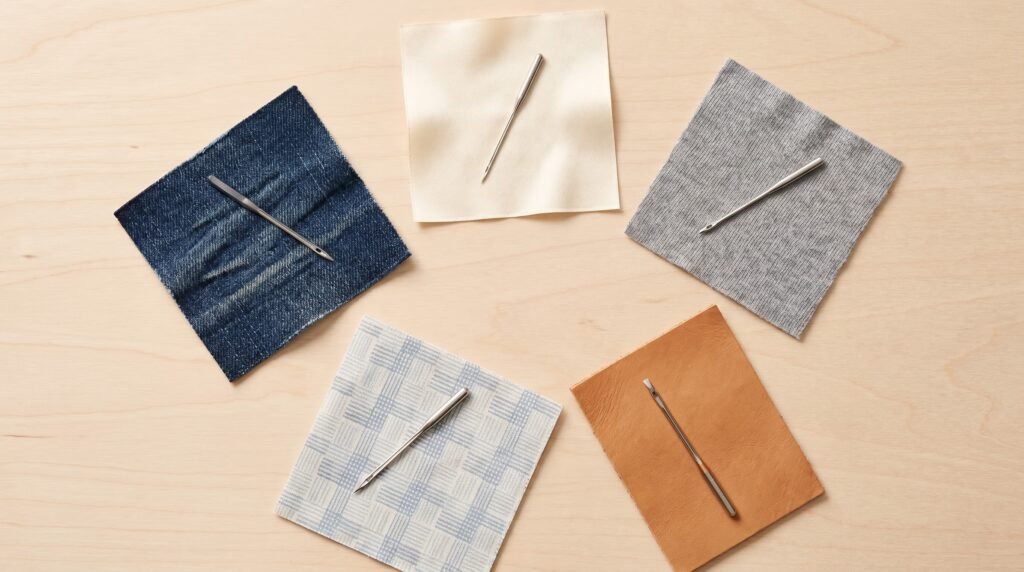
The table below pairs each needle type to its defining design feature, primary fabric match, and the symptom that tells you to swap to it. For brand comparisons across these types, Schmetz, Organ, and Klasse all produce the full range in the 130/705 H system.
| Needle type | Point design | Key feature | Primary fabrics | Reach for it when... |
|---|---|---|---|---|
| Universal | Slightly rounded | All-purpose compromise | Wovens; stable knits | General sewing; you don't know the fabric content |
| Ballpoint / Jersey | Round blunt tip | Pushes fibers apart, doesn't pierce | Cotton jersey, interlock, fleece, rib knit | Skipped stitches or snags on knits |
| Stretch | Medium ball point + deep scarf | Deep scarf catches loop despite fabric pull | Lycra, Spandex, swimwear, power net | Jersey needle still skips on high-stretch fabric |
| Denim / Jeans | Very sharp; stiffened blade | Pierces dense weave; resists deflection | Denim, canvas, heavy twill, workwear | Needle bending or breaking on thick layers |
| Leather | Chisel / cutting point | Slices a clean hole in hide | Genuine leather, real suede, vinyl | Sewing real hide or vinyl (not faux suede or PU) |
| Microtex / Sharp | Acute straight tip | Precision entry; reduced puckering | Silk, microfiber, fine cotton, batiste | Puckering or wavy seams on fine wovens |
| Quilting | Slightly rounded, tapered | Strengthened shaft; handles layer junctions | Quilting cotton + batting layers | Skipped stitches when sewing through thick quilt sandwiches |
| Topstitch | Slightly rounded (Schmetz) / extra sharp (Klasse); elongated eye | Large eye handles heavy decorative thread | Any fabric with heavy/metallic topstitch thread | Thread shredding or skipping with heavy decorative thread |
A note on the 130/705 H system and compatibility
All eight types above fit the 130/705 H system - the flat-shank, scarfed needle standard used by Bernina, Brother, Janome, Juki, Pfaff, Singer, Viking, and most other home machine brands. Schmetz confirms compatibility "with all these home sewing machine brands in the marketplace," with two caveats: "a few older Singer machines that require a different needle system" and specialty machines like needle-felting or sashiko machines that use different systems entirely.
If you own a vintage machine made before the 130/705 H standardization became universal, check your manual before assuming compatibility. The flat shank will visually fit, but the shank thickness tolerances on a few older systems differ enough to affect timing.
Schmetz, Organ, and Klasse all produce the full range in this system. Organ is the brand Brother recommends for their machines and is widely available at lower price points. Schmetz carries the widest variety of specialty types. Klasse sits between them on price. All three meet the 130/705 H spec.
Questions answered
Can I use a ballpoint needle for all knit fabrics?
For most knits - jersey, interlock, cotton-lycra, fleece, ribbing - a ballpoint or jersey needle works well. On fabric with significant Spandex or Lycra content (swimwear, active wear, power net), upgrade to a stretch needle. The deeper scarf on a stretch needle handles the extra elasticity; the standard ballpoint can still produce occasional skipped stitches on those materials.
What's the difference between a Jersey needle and a Stretch needle?
Jersey (ballpoint) has a rounded tip that pushes fibers apart - good for most knits. The stretch needle adds a deeper scarf above the eye, which gives the bobbin hook more room to catch the thread loop as elastic fabric pulls the needle slightly off its descending path. Use jersey for stable knits; use stretch for Lycra, Spandex, swimwear, and power net - essentially any fabric whose elasticity causes the jersey needle to still skip stitches.
Will a leather needle work on faux leather or vinyl?
Genuine vinyl: yes, Singer lists it for "leather and vinyl." Faux suede, ultra suede, or PU imitation leather: no. Klasse's guidance is explicit - "not suitable for ultra suede, synthetic suede, or PU imitation leather." The chisel point cuts through real hide cleanly, but in bonded or PU materials those cut holes tear out under tension rather than holding the stitch.
Why do I need a quilting needle if I already have a universal?
The quilting needle's strengthened, tapered shaft resists deflection when the needle must pierce multiple fabric layers converging at seam junctions inside a quilt sandwich. A universal needle at those thick points can skew slightly and cause skipped stitches or uneven stitch size. The difference becomes noticeable at 3 or more layers, especially near piecing intersections where several seam allowances stack.
When should I use a topstitch needle versus a standard needle with regular thread?
Use the topstitch needle any time you are loading thread heavier than standard 40-weight into the machine - topstitching thread, buttonhole twist, 30-weight or 12-weight decorative thread, or metallic thread. The elongated eye reduces the friction angle that frays heavy thread at speed. On standard 50-weight cotton or 40-weight polyester, a universal or microtex needle does the job without the oversized eye.
- Schmetz NeedlesNeedle Anatomy guide
- Schmetz NeedlesUniversal and Stretch collection pages
- Klasse NeedlesChoosing the Right Needle
- Singer SupportChoosing the Right Singer Machine Needles
- Brother USA Supportneedle type for stretch fabrics
- Schmetz NeedlesMicrotex home sewing needles collection
- Schmetz NeedlesDo You Know Your Sewing Machine Needle Points?
- Schmetz NeedlesTopstitch product page
The Stitchmend team
Every fix here is built from manufacturer service manuals and needle-maker specs, and fact-checked against those sources before it goes live. How we work