Sewing machine skipping stitches: causes and fixes, ranked most to least likely
Nine times out of ten, skipped stitches come down to the needle. Here is how to confirm it, fix it fast, and know when timing is actually the problem.
You hear the machine running, the fabric moves through, and the stitch line has gaps - sections where the thread simply did not lock. Nine times out of ten, the cause is the needle: wrong type for the fabric, dulled past its useful life, or seated slightly off-center in the clamp. Any of those conditions breaks the tight geometry a stitch needs to form. Threading problems and machine timing can produce identical-looking gaps, but both are far less common. Working through the needle first resolves most cases quickly and avoids chasing causes that are not there.
Here is the quick version for anyone mid-project: swap in a fresh needle of the correct type, rethread with the presser foot raised, and confirm the needle shank is seated fully into the clamp - no gap between the shank top and the clamp ceiling. That sequence fixes the overwhelming majority of cases. The rest of this guide covers why each step matters and how to read the remaining causes in order.
Why the needle is the first place to look
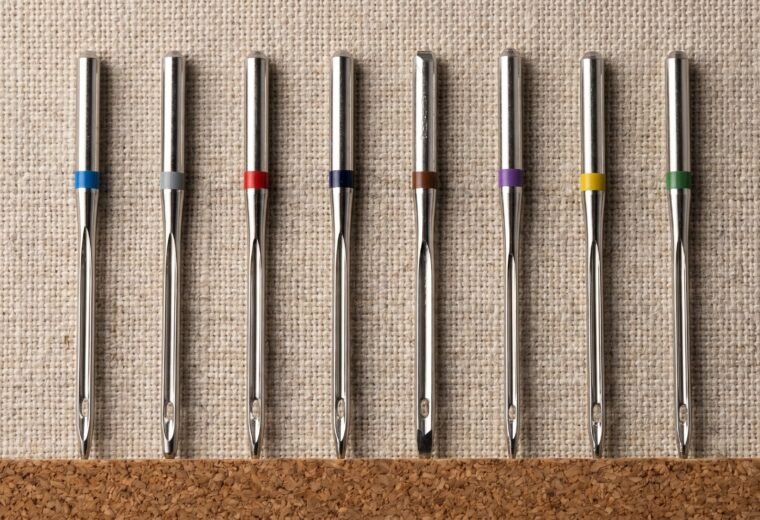
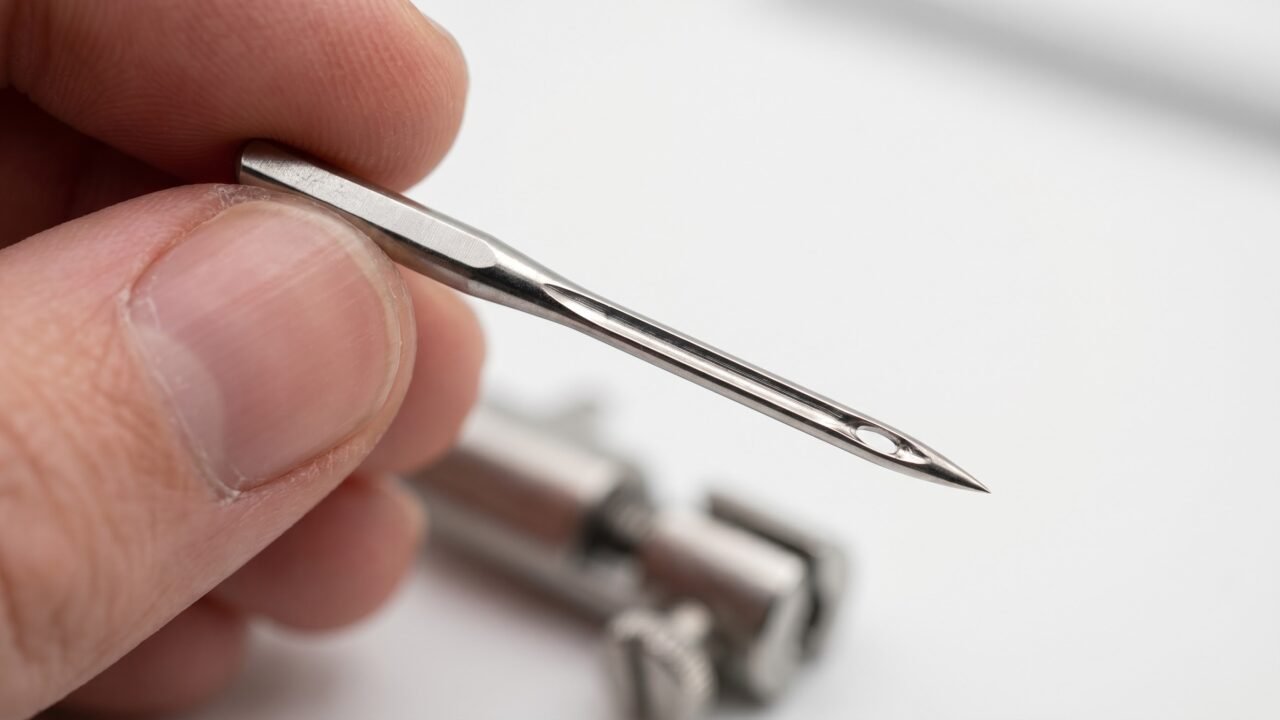
Home sewing machines almost universally use the 130/705 H needle system - Schmetz puts the figure at 99% of all home machines. The "H" in that designation comes from a German word meaning scarf, referring to the small indentation on the back of the needle just above the eye. That scarf is exactly where the hook passes to grab the thread loop and form a stitch. When the needle is bent, dull, or the wrong size, the scarf and the hook fall out of sync by fractions of a millimeter - enough to miss every single stitch.
Schmetz's technical documentation is direct on this: "Needle deflection, skipped stitches, and broken needles are a sign of using the wrong needle size." A too-thin needle deflects slightly as it enters the fabric; the hook swings through where the scarf should be, finds nothing, and the stitch is skipped. A dull needle drags rather than piercing cleanly, causing the same off-axis wobble. You do not need to see the deformation - if stitches are skipping, a fresh correct needle is the right starting move.
The right trigger for changing the needle is symptom-based: skipped stitches, shredded or broken thread, popping sounds as the needle enters the fabric, or puckering on fabric that used to sew cleanly. Those signs are more reliable than a clock. As a rough upper-bound guideline, needle manufacturers including Organ Needles suggest replacing after roughly 6-8 hours of actual sewing time - but treat that as a ceiling, not a schedule. Change sooner whenever symptoms appear, at the start of each new project, or after sewing dense material like denim or canvas that dulls a point quickly. The Stitchmend needle types guide covers the full range of 130/705 options if you want to match needle type to fabric in more detail.
How to confirm it and fix it: the ranked checklist
Run these in order. Each step takes under two minutes. Most people find the problem by step three.
- Install a fresh needle of the correct type and size. Slide the shank up until it contacts the top of the clamp - leaving even a small gap here is the single most common installation mistake. Singer's official guidance specifies the flat of the shank should face the back of the machine (check your manual; a few older models differ). Tighten the clamp screw firmly. Needle sizes use a dual notation: 80/12 for lightweight cotton, 90/14 for medium-weight fabric, 100/16 for denim or canvas. Sizes are always shown as Euro/US.
- Rethread the machine with the presser foot raised. Lowering the presser foot closes the tension discs around the thread. Threading with the foot down means the thread never seats in those discs, so tension never engages, and the hook finds a slack loop instead of a taut one. Singer help puts this plainly: "Always, always raise the presser foot lifter before you start threading the machine." After rethreading, also confirm the thread is fully seated in the take-up lever - a missed guide here is a frequent culprit. The broader pattern of what threading errors look like on the stitch is covered in how to read your stitch.
- Check needle direction. Reinstall and confirm the flat side of the shank faces the back of the machine (standard on almost all modern machines). On a handful of older Singer models such as the Featherweight, the flat faces left - your machine's manual is the authority here. Wrong orientation, even by 180 degrees, prevents the hook from reaching the thread loop.
- Rethread the bobbin. A bobbin that is loaded in the wrong direction, sitting slightly unlevel, or running low on thread can mimic a needle problem. Remove it, reload it per your machine's diagram, and leave a clean tail coming off the correct side. If your machine has a front-loading bobbin, make sure the case clicks into position - a partially seated case skews the hook geometry.
- Clean the race area. Lint packed around the hook and in the bobbin race can physically deflect the needle just enough to cause skips. Use a small brush or a vacuum nozzle held close - never compressed air, which drives lint deeper into the mechanism, and never WD-40 or household oil, which gum up the race over time. A proper brush-out takes 60 seconds. Cleaning method and oiling schedule are covered in the cleaning and oiling guide.
The fabric-to-needle match: where knits and stretch go wrong
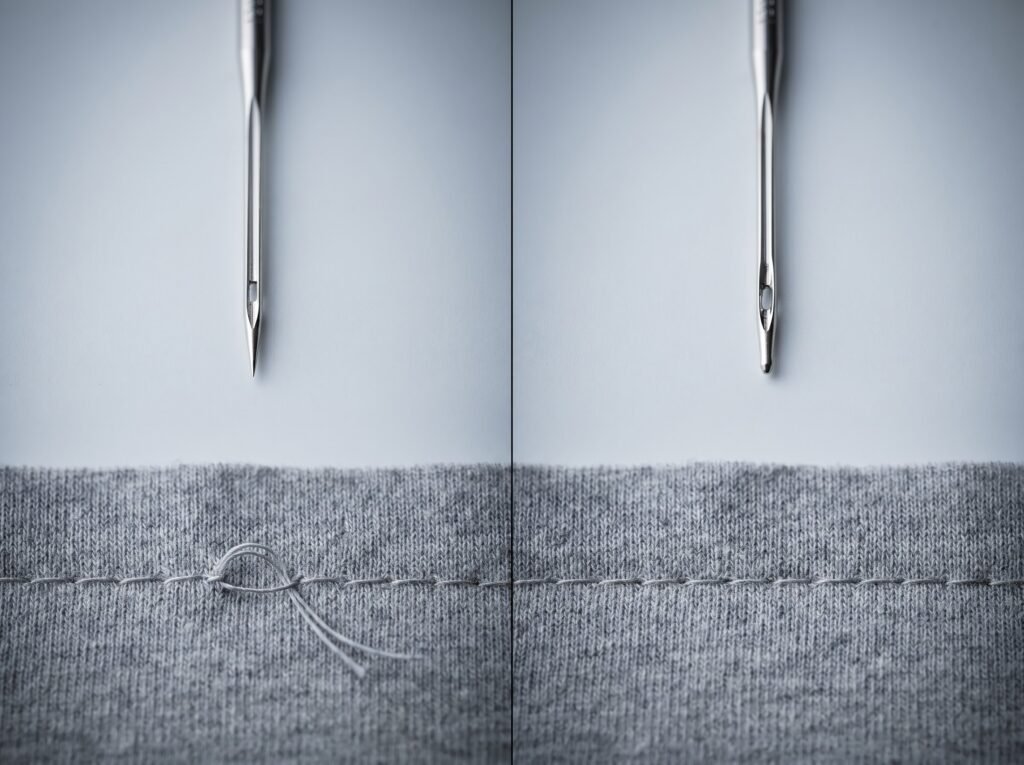
A universal needle on a jersey T-shirt or a swimsuit fabric is the single most common "I tried everything" situation. The reason is mechanical: a universal needle has a sharp point that pushes knit loops sideways rather than passing between them. That lateral push deflects the needle off its path to the hook, and the stitch is missed. Skips on knit fabric are not a machine problem - they disappear the moment you put in the right needle.
The correct choice for knit, jersey, or any fabric containing Lycra or spandex is a ballpoint or stretch needle. Both brands agree: Brother's official support states "use the ball point needle when sewing on stretch fabrics or fabrics where skipped stitches easily occur," specifying the Organ HG-4BR as their recommended needle with Schmetz Jersey Ballpoint 130/705H SUK 90/14 as a direct substitute. Schmetz describes their Stretch needle as having "a medium ball point, a smaller eye, and a deep scarf" - each feature working together to prevent skips on highly elastic fabric.
The table below maps the most common fabric types to the correct needle, along with the sizes that prevent skipping without damaging the material.
| Fabric type | Needle type | Recommended size (Euro/US) | Why skips happen with the wrong needle |
|---|---|---|---|
| Woven cotton, linen, canvas | Universal (130/705 H) | 80/12 - 90/14 | Needle too fine for fabric weight deflects off center |
| Jersey, T-shirt knit | Ballpoint / Jersey (130/705 H-SUK) | 80/12 - 90/14 | Sharp point pushes knit loops, deflects needle |
| Swimwear, Lycra, spandex | Stretch (130/705 H-S) | 75/11 - 90/14 | Without deep scarf, hook misses elastic-distorted loop |
| Denim, heavy canvas | Denim / Jeans (130/705 H-J) | 90/14 - 100/16 | Thin needle deflects; missed loop on every other stitch |
| Sheer silk, chiffon | Microtex / Sharp (130/705 H-M) | 60/8 - 70/10 | Too-large needle creates hole larger than thread; loop distorts |
| Fleece, French terry | Jersey / Stretch (130/705 H-SUK or H-S) | 80/12 - 90/14 | Lofted pile deflects universal needle off axis |
For a deeper look at how needle brands compare - Schmetz, Organ, and Klasse all fit the same 130/705 system - the needles overview and needle types guide cover the differences in point geometry and when each matters.
When it actually is timing
Timing is the synchronization between the needle and the hook below the throat plate. The hook must pass just above the needle's eye at the precise moment the needle begins to rise - sewing machine technician and writer Cale Schoenberg places that window at 2-3 mm above the needle's lowest position. A machine that is out of time misses that window. Same symptom as a bad needle, but no needle change fixes it.
Before concluding timing is the culprit, exhaust the checklist above - in repair practice, a significant share of suspected timing problems turn out to be a needle or threading issue once those are properly ruled out. Schoenberg notes that "the most common reason a machine goes out of time is when we try to sew through something too thick" - so there is usually a clear event: sewing through multiple thick seams, hitting a pin, or forcing a jammed machine. If skips appeared without any such incident, and a fresh correct needle plus a full rethread did not resolve them, timing is a real possibility. The is-it-timing-or-not guide walks through exactly how to tell the difference, including what the stitch pattern looks like when timing is the actual cause.
Fixing timing yourself sits at the more advanced end of DIY sewing-machine repair. Singer UK specifies the reference point: stop turning the handwheel when the needle is exactly 2.2 mm above its lowest position; at that moment the needle should be "inline with the hook point" and "the needle eye must be just below the hook point." That is a tolerance measured in fractions of a millimeter. It is achievable at home on many machines with patience and the right screwdriver, but it requires removing the throat plate, watching the hook-needle gap while turning the handwheel by hand, and knowing which screws to loosen on your specific machine. Schoenberg's recommendation for out-of-time machines is a trained technician, and that is the safer path if you have any doubt. Details on what the repair actually involves are at how to fix timing, and if the machine is older or the repair bill climbs, the repair-vs-replace guide helps put the cost in context.
One more threading note: the take-up lever
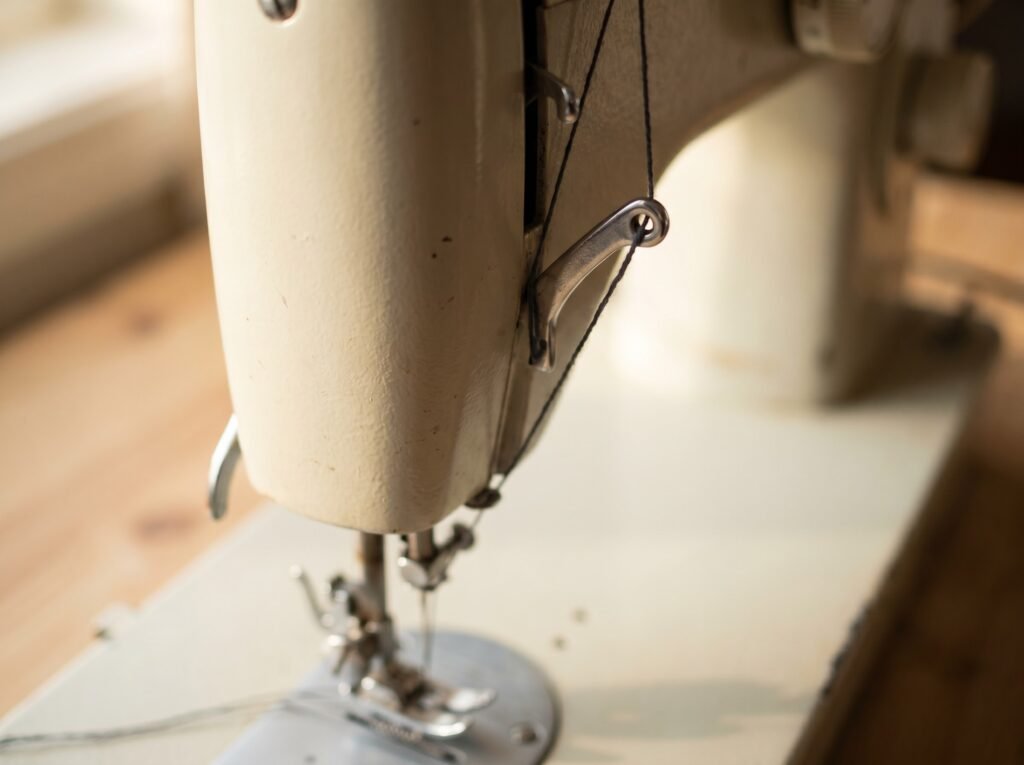
Threading errors can mimic timing with uncanny accuracy. The take-up lever - the moving arm that rises as the needle rises - pulls the thread back up through the fabric to seat the knot. If the thread skips the take-up lever during threading, there is no tension on the upswing, the loop forms wrong, and the hook catches nothing. Singer's threading documentation specifically flags it: "Make sure the thread is properly placed in the take-up lever of the machine."
A quick check: cut the thread, raise the presser foot, and rethread from the spool to the needle eye in one slow pass, confirming each guide in sequence. On machines where the path wraps around a horizontal disc before the take-up lever, it is easy to skip that disc entirely - especially under bad lighting or when threading quickly mid-project.
If the stitch is forming but looks wrong rather than completely absent, reading the stitch itself points you to the source. Loops on the underside mean the top thread is too loose or not properly tensioned - nearly always a threading issue. That diagnostic is covered step by step in how to read your stitch and in the full troubleshooting index.
Questions answered
Why does my sewing machine skip stitches only on knit fabric?
A universal needle's sharp point pushes knit loops sideways instead of passing between them, which deflects the needle off its path to the hook. The fix is a ballpoint or Jersey needle (130/705 H-SUK) in size 80/12 or 90/14. That single swap eliminates knit skipping in the large majority of cases - no tension adjustment needed.
How do I know if the problem is the needle or machine timing?
Start with the needle. Install a fresh correct-type needle, rethread with the presser foot raised, and confirm the shank is seated fully at the top of the clamp with no gap. If skips persist after all of that, and especially if the skipping started after sewing thick fabric or hitting a pin, timing becomes a real possibility. The is-it-timing-or-not guide has a clear diagnostic walkthrough.
Which direction does the flat of the needle shank face?
On most modern home machines, the flat side of the 130/705 needle shank faces the back of the machine. A handful of older Singer models (including the Featherweight) orient the flat to the left. The definitive answer is in your machine's manual - it takes 30 seconds to confirm and wrong orientation prevents stitch formation completely.
Can I keep sewing if the machine is skipping stitches?
A few skips for a quick test while diagnosing is fine. Continuing to sew on a skipping machine for a full project is not a good idea - the stitch line is structurally weak wherever stitches are absent, and if the cause is a bent needle it can break and become a safety hazard. Fix the skip before finishing the project.
How often should I change the needle?
Watch for symptoms first: skipped stitches, shredded thread, or popping sounds when the needle enters the fabric are more reliable signals than a timer. As a rough ceiling, needle manufacturers including Organ Needles suggest 6-8 hours of actual sewing time, but change sooner whenever symptoms appear or at the start of each new project. If you sew through heavy denim or canvas, change the needle more often - those fabrics dull a point faster than lightweight cotton does. A new needle costs cents; a ruined piece of fabric or a broken needle inside the machine costs far more.
- Schmetz NeedlesFAQ
- Schmetz NeedlesStretch needle collection
- SingerMachine FAQs and helpful tips
- Brother USA SupportNeedle type for stretch fabrics
- Sewing Machine Man (Cale Schoenberg)Sewing Machine Timing
- Diamond Needle / Organ NeedlesWhen to Change Your Sewing Machine Needle
The Stitchmend team
Every fix here is built from manufacturer service manuals and needle-maker specs, and fact-checked against those sources before it goes live. How we work